Showing posts with label Hildagonda Duckitt. Show all posts

Friday, 15 August 2025

A Celebration of Citron

 “It looks like the beginning of an idea about fruit, a rough prototype made at an early stage of the design process, a crude unfinished thing, a dinosaur that evaded extinction, a Neanderthal on a tree.”


That is how Helena Attlee describes the Citron in her amazing book, The Land Where Lemons Grow, a unique culinary adventure through Italian citrus history. My first experience of the fruit was one of amazed bewilderment. Apart from being enormous, the fruit resembles a kind of citrus, but it appears more ancient. Looking at the bowl of Citrons on the dining room table I was reminded of the fruit’s rich history. It was like having a bowl of history on the table. The heady fragrance of the Citrons filled the room and soon permeated through the rest of the house.


But, I am getting ahead of myself. The bowl of history landed on the table through the generosity of a friend who has access to a Citron tree on a family farm at Swellendam. Apart from the history of the fruit, I was gifted with the agricultural history of Swellendam and the region at the same time.

Orange and lemon trees were introduced to the Cape in 1654 from St Helena and planted in the Cape Town Company Gardens, but the history of how and when the Citron itself came to South Africa is not very clear.  It was possibly brought to the Cape for domestic culinary reasons. There is enough evidence that Citron preserve was made at the Cape in the 1700’s and possibly before that. In her cookbook, Hilda’s “Where is It” of Recipes, published in 1891, Hildagonda Duckitt records a Citron Preserve recipe from her grandmother’s recipe book. I trust it would be her maternal grandmother, Maria Catharina Persoon, 1760 – 8 June 1834. I muse that she in turn might have inherited it from her grandmother, Margaretha Hattingh, 1700 – 8 April 1779.

Still Life with Bowl of Citrons, Giovanna Garzoni, 1640
To discover that Hildagonda Duckitt was my fifth cousin, twice removed, was a pleasant surprise. Searching for the origins of traditional recipes took me back to my own origins and gave me more to chew on than just Citron preserve.

The historical culinary author, A G, Hewitt does not indicate the origin of the citron preserve recipe that she recorded in Cape Cookery: Simple Yet Distinctive, 1890.


With a generous number of Citrons in the house, I set out on a discovery of how to use this great- great grandfather of all citrus fruit. In the book, The Land Where Lemons Grow, Helena Attlee explores the colourful past of six different kinds of Italian citrus and their contribution to the history of Italy. One of these is the arrival of Citrons in second century Calabria.

Mosaics dating back to the  4th century AD, at Villa Romana del Casale, depicting citrons 
The chapter on the Citron explores its culinary uses and the pursuit of the perfect Citron by Jewish people for use in a religious ritual celebrating the holiday of Sukkot. During this harvest festival the etrog (Citron) is the centerpiece of the tradition. Some devout buyers will even pay thousands of dollars (US) for a single perfect specimen.

A citron next to a matchbox for size comparison
Inspired, I decided that I wanted to make as many dishes as possible with the Citrons,  using every part of it from the rind to the pith and the flesh. I made Cedrello, a liqueur made by infusing the peel and zest of the Citron fruit in alcohol. I used the pith to make Citron preserve, candied Citron peel, and Insalata di Cedro. With the centre fruit part, I made a Citron syrup that can be topped up with sparkling water to make the refreshing drink Cedrata.

Towerwater Cedrello
It is truly amazing what one can make with Citron, and I have not yet explored all the savoury dishes for which one might use the pith. But that will have to wait until next Citron season. Marveling at all the produce that I could make from Citron, I still detect the bright, crisp citrus fragrance of the Citron, with its additional notes of subtle floral, herbal, and even slightly bitter undertones, lingering in the rooms of Towerwater.

Citron Recipes

Friday, 8 August 2025

Citron Preserve

With an abundant supply of fresh organic citrons, I could not wait to try my hand at traditional citron preserve. As usual, I consulted the earliest Cape cookbooks in the Towerwater library. I was tempted to use the recipe of Hildagonda Duckitt’s grandmother but decided instead to use a recipe that does not involve using an egg to clarify the preserve. Using eggs to clarify jam was just a bit advanced for me.


I decided to use the recipe in The South African Culinary Tradition by Renata Coetzee, published in 1977.


Citron preserve
The South African Culinary Tradition, Renata Coetzee, published in 1977

The fruit must be plump, but the peel must still be green.

Grate off the peel or peel the fruit very thinly and cut the citrons into quarters. Remove the flesh. Only the rinds are used for preserves. Soak rinds for two days in fresh water, replacing the water at least once.


Drain and plunge the citron pieces into boiling water. Cook until the rind is so soft that it can easily be pierced with a matchstick. Drain the citron pieces and p
ress all the water out carefully.


Make a syrup of 500 g sugar for every 500 g fruit and use three to four cups (750 ml - 1 l) water for every 500 g sugar. Add three tablespoons (37,5 ml) lemon juice to every kilogram of fruit.

Place the citrons in the boiling syrup and boil rapidly until the fruit is translucent and the syrup thick and has the right heavy consistency. Skim off and pack the citron pieces neatly into sterilized jars. Fill with syrup and seal.


When I explored the history of citron preserve at the Cape, I discovered that it was used in several dishes in its candied and preserved form. It was used to flavour and decorate cakes, puddings and biscuits. I suppose that is why citron trees were commonplace in the agricultural landscape of both the rural and suburban Cape.

The recipes for citron preserve have been fairly consistent over the years with salt added to soaking water by Hildagonda Duckitt, and salt added to the first boiling process by A.G. Hewitt to preserve the green colour of the preserve.  


I include the recipes for citron preserve as recorded since 1890 by different historical cooks. The recipes are as found in the different cookbooks.

Citron  Konfyt
Cape Cookery Simple Yet Distinctive, A.G. Hewitt, published in 1890

The citrons must not be ripe. Pare the citrons and quarter them, using only the peel. Soak the pieces in fresh water every day for 3 days.

Boil them up in water, adding a large spoonful of salt to keep the green colour. When taken out of the water squeeze them quite dry. Prepare the syrup, weight for weight, fruit and sugar, and boil all till clear.


Image of Citron Preserve cooking from The South African Culinary Tradition by Renata Coetzee

Preserve (Citron)
Hilda’s “Where Is It “of Recipes, Hildagonda Duckitt, published in 1891

(From my Grandmother's Recipe Book. Dutch.)

Scrape the rind, cut in halves, take out the pulp, lay them in a basin of hot water to which a handful of salt was added; change the water the next day, then leave for two days longer in water; after that, boil them in clean water till soft enough to put a reed through. Press all the water out carefully, laying on a cloth to cool. For each pound of fruit take two of sugar; make a syrup of the sugar (one cup of water for a cup of sugar), clarify with an egg. Boil for two days on a slow fire. Keep well corked in glass bottles


Citron Konfyt
The Practical Cookery Book for South Africa, S.H. Van Tulleken, published in 1923

This is the most delicious and the prettiest of all citrus fruit konfyts, and instead of yielding a yellow konfyt, it is a beautiful green when done, and transparent like glass. Cut them in quarters or when the fruit is not too large in halves; they can also be cut in rings 1 inch thick, by cutting through the fruit and removing the pulp with a spoon, this is rather difficult, as the inside is pretty tough. Care should be taken to remove the pulp only, and not part of the peel as well. Before cutting the fruit as above, first peel very thinly, just cutting through the pores. The surface is very uneven, and it is rather a trouble to peel them nicely. Don't cut away the uneven, places—peel right over them, just cutting through the pores, and leaving the peel uneven. Now place the peel in cold water, only changing the water on the second day as for oranges. The fruit is very slightly bitter, and of such delicious flavour that it would the greatest pity to change the water too often. The object is to soak the peal. On the third day start early, and boil the peel in clean water till it can very easily be pierced with a little stick or straw – it should be very soft and transparent looking. Now weigh, allowing the same quantities of sugar and water as for oranges, also for thinning syrup. Proceed exactly as for orange konfyt.  (Use  insides scooped out for jelly); Close the bottles when konfyt is quite hot to prevent sugaring.


Citron  Konfyt

Old-Time Recipes, edited by E. Barnard, published in 1952

Citrons should be unripe and green in colour and are usually ready for preserving in March. Scrape the citrons with a piece of glass. Quarter them and take out the pulp. Lay them in basin of hot water to which a handful of salt has been added.

Next day change the water and leave for 3 days in fresh water every day, then boil in clean water until soft enough to pierce with a reed or a skewer. Squeeze the pieces dry and lay them on cloth to drain.  For 1 lb. of fruit take 2 lb. of sugar.  Make a syrup of 1 cup of water to 1 cup of sugar. Add the fruit and boil gently over a slow fire until clear. Bottle.

Other Citron Recipes

Thursday, 7 August 2025

Candied Citron Peel

Candied citron was popular as early as the Middle Ages and the Renaissance. The first recipes for candied citron were recorded by the unknown author of the 14th-century Egyptian cookbook Kanz al-Fawa'id fi Tanwi' al-Mawa'id, translated as Treasure Trove of Benefits and Variety at the Table.


Bartolomeo Scappi's 16th-century cookbook, Opera di Bartolomeo Scappi, includes recipes for candied citron, which he called "cedro," as part of the elaborate meals of his time. He detailed the process of candying the thick, edible rind of the citron, in his recipes. The candied citron was often used as a sweet treat as well as a flavour component in other dishes. Over 700 years not much has changed in the culinary use of candied citron.

 A painting of the Medici citrus collection c.1715 by Bartolomeo Bimbi
I used the recipe for candied citron peel in Annette Human’s book, Lekker vir Later published in 2002. It is a voluminous cookbook that has a recipe for seemingly everything that can possibly be done with vegetables and fruit.


Candied Citron Peel
Lekker vir Later, Annette Human, 2002

Cut a thin slice of peel from the stem and blossom ends of 2 large citrons. Make wide vertical cuts from top to bottom all the way through the peel to the flesh of each citron. Remove the strips of peel and cut them into 1 cm wide strips.

Quickly boil the peels in 2 litres of water until they are so soft that a match can easily be inserted through them. Drain the peels.


Slowly heat 500 ml of water and 400 g of white sugar to the boil, stirring at the beginning until all the sugar has dissolved. Remove the saucepan from the stove and place the peels in the syrup. Leave to macerate at room temperature for 8 hours.


Heat the syrup with the peels very slowly until the peels have absorbed all the syrup. This should take about half an hour; keep a close eye on the peels, especially towards the end, to ensure they do not burn. Carefully remove the peels with kitchen tongs and leave to dry on aluminum foil for 12 hours.

The next day, roll the peels one by one in white sugar until well coated and leave to dry on a wire rack for about 3 hours.


Pack the sugared peel between layers of wax paper in an airtight container and store in a cool, dry place for up to 2 months.

I could not find a recipe for candied citron in Hildagonda Duckitt’s, Hilda’s “Where Is It “of Recipes, published in 1891. She did however share some recipes that included candied citron, like macaroons and plum pudding. I share them in this post for anybody that might like to explore the culinary possibilities of this delicacy even further.

Macaroons (Another Recipe)
(Mrs. J. Cloete’s)
Hilda’s “Where Is It “of Recipes, Hildagonda Duckitt, published in 1891

Ingredients:

1lb. Almonds blanched and pounded.
The Whites of 4 Eggs.
1 lb. sifted Sugar
½ teaspoonful of Cinnamon.

Blanch and pound the almonds, adding a little rosewater while pounding. Mix with the sugar, which should be slightly warmed, then stir the whites of the eggs well whisked. Butter a paper and lay it on a baking-pan; with a fork put small lumps of the paste on the paper. Bake in a moderately slow oven for twenty minutes. A small piece of candied citron stuck into each little cake is a great improvement. Very good.


Pudding (Plum).

(Old English Recipe.)
Hilda’s “Where Is It “of Recipes, Hildagonda Duckitt, published in 1891

1 lb. Raisins.
1 lb. Currants.
1 lb. Beef Suet.
½ lb. Candied Citron,
¾ lb. Sugar.

Ingredients.

7 Eggs.
2 oz. Flour.
1 tablespoonful of Mixed Spices (Ginger, Cinnamon, Nutmeg)
1 tumbler of Brandy

Stone and clean the raisins, wipe the currants ; cut the beef suet very fine, also the candied citron ; whisk the whites and yolks separately ; mix all together. Boil in a well-floured cloth, or mould, for six hours. Improves by being made weeks before, and kept till wanted. Very good.


It is clear from Hildagonda Duckitt that preserved citron was popular in English and Dutch recipes.

Other Citron Recipes

Saturday, 12 March 2022

Citron Preserve, soul food from the heart

 (Loosely translated into English from my blogpost Siterkonfyt: Hartskos uit die hart uit)

Recently, I took a basket of fresh fruit from the garden to a friend down the road for her to use in preserve making. She makes the most delicious homemade preserves and jams which she then sells. After unpacking the basket of fruit in her kitchen, she returned to the sitting room with a jar of preserve asking, “Do you know what this is?”


I immediately recognised the soft green of the Citron Preserve. My heart skipped a beat as nostalgic memories of this exquisite preserve welled up. In South Africa, we have iconic preserves that are integral to our indigenous cultural and culinary traditions. Green figs, Wild Watermelon (Makataan) and Cucumis Anguria (Agurkie) to mention but a few.
 

Citron Preserve is a delicacy on its own. I can distinctly recall, over a period of decades, when I ate it and who made it. I recall Jean Visser, who was married to the restoration architect Dirk Visser, and her serving her homemade Citron Preserve at the large yellowwood table in their home Vredenburg in Rosebank, Cape Town.

When my friend presented me with the jar of Citron Preserve with the words, “This is to say thank you from the bottom of my heart”, I immediately understood. Citron Preserve is only made for the love of it and its indulgent pleasure. Citron Preserve takes time. Some recipes require the thick peel to be steeped in water for four days.

Still Life with Bowl of Citrons, Giovanna Garzoni, Italy circa 1645, J. Paul Getty Museum
The Citron (Citrus medica) is a large fragrant citrus fruit with a thick peel. It is also one of the progenitors from which all citrus fruits evolved, through either natural or human intervention. It is therefore the forerunner of the citrus fruits we know today.

Photo of citrons in copper pot, Spys en Drank, Renata Coetzee, 1977
To prepare Citron Preserve is akin to bottling the history of the evolution of citrus. I researched the history of Citron Preserve-making in South Africa. The three earliest recipes I could find were clearly very familiar to the public when they were first published. It is most likely that they were already well known in the 1700’s or earlier, at the Cape.

Recipe from “Cape Cookery. Simple Yet Distinctive – Hewitt, A G, 1890”

“Citron Konfyt

The Citrons must not be ripe. Pare the Citrons and quarter them, using only the peel. Soak the pieces in fresh water every day for 3 days.

Boil them up in water, adding a large spoonful of salt to keep the colour. When taken out of the water squeeze them quite dry. Prepare the syrup, weight for weight, fruit and sugar, and boil all till clear.”

The recipe is short and sweet and not for beginners. Clearly, it was assumed that if you were going to tackle Citron Preserve, you were well versed in Preserves and would know instinctively how to proceed.


Recipe from “Di Suid-Afrikaanse kook-, koek- en resepteboek – Dijkman, E J, 1891”

“Citron Preserve, No.1

Peel thinly and weigh off. Cut into four parts. Steep in cold water for two days replacing the cold water twice daily. On the third day place in boiling water and cook until soft. Place outdoors on a cloth to dry. Take as much sugar equal in weight to the Citrons. (Make the syrup equal parts water and sugar). Scoop and pour until sugar well dissolved. Add the Citrons and simmer until soft and clear. Bottle as for other preserves once well cooled."


Recipe from “Hilda's diary of a Cape housekeeper – Duckitt, H J, 1902”

“Mrs. Breda’s Citron Preserve. —Citrons preserved in the following way make a nice dish for dessert now that fresh fruits are scarce. It is Mrs. Breda’s recipe, and is best done in two days. To every half-dozen green citrons you will require their weight in sugar before scraping.

Pare or scrape the citrons, using a medium-sized grater, then lay them whole in a deep bowl, and after sprinkling 2 or 3 ozs. of salt over them, cover the citrons with a plate to keep them from rising, and pour into the bowl boiling water sufficient to cover the fruit.

The next day halve or quarter the citrons, taking out the pulp carefully (as this being bitter is never used), lay them in your copper preserving-pan, sprinkle a handful of salt over them, and cover them with cold water. Set the pan on the fire to boil till the fruit is soft enough to pierce with a reed or blunt skewer. Then take the pieces of citron out with a spoon, and put them into very cold water for half-an-hour, after which squeeze them as dry as you can without breaking. Now put your fruit into the preserving-pan and cover with sugar, same weight as the fruit, and measuring the sugar (after being weighed) with a cup, take in proportion 4 cups of water to 6 cups of sugar, let it melt and boil it up slowly, setting aside for next day when it should boil—say 4 or 5 hours—till clear and syrup nice and oily.

The citron preserve we make can be candied, but we keep it in jars in syrup, and drain it off a few days before we want to use it, roll it in dry sugar, and dry in a cool oven or on a cake-tray in the sun and air. We do the green figs in the same way.”


Mrs S van H Tulleken describes the Citron, or Citron preserve, in “Die Praktiese Kookboek vir Suid Afrika, 1922” as follows. 
“It is the most delicious and beautiful of all citrus preserves. Instead of yellow as for other citrus preserves, it is a beautiful green and as transparent as glass”. For me, this is a perfect description of Citron Preserve.

Mrs S van H Tulleken was a lecturer in Domestic Science. She was a judge at agricultural shows that also gave demonstrations. She was regularly awarded prizes at agricultural shows for her jams, cakes, tarts and preserves.

Anyone who may remember those agricultural shows will know just how competitive they could be. I become nostalgic when I think back to the agricultural shows of the town of Worcester in the Cape, and the produce on display in the great halls near the Kleinplasie outdoor museum. The halls were cathedrals of produce of the highest quality that the region could produce. Here it was all about quality, presentation and taste. Therefore, when Mrs S van H Tulleken describes Citron Preserve as the most delicious and beautiful of all citrus preserves and jams, it is by no means a lighthearted assessment.


To enjoy the green-coloured glassy preserve on a fresh slice of home-baked bread is the ultimate taste sensation. Real soul food from the heart.


Siterkonfyt, hartskos uit die hart uit

Siterkonfyt, hartskos uit die hart uit

Die ander dag neem ek ‘n mandjie vrugte vir ‘n vriendin onder in ons straat, vir konfyt maak. Sy maak die heerlikste konfyt wat sy verkoop. Nadat sy die mandjie vrugte wat ek vir haar gebring in haar kombuis uitgepak het, kom sy haar sitkamer binne met ‘n vlessie konfyt en vra vir my, “Ken jy dit?”


Ek herken onmiddelik die sagte groen van die gekookte siterkonfyt in die vles. My hart gee ‘n bons en herinneringe van die lekerste lekker kom by my op. In Suid-Afrika het ons ikoniese konfyte wat deel is van ons kultuur en eet tradisies. Groenvye, Wilde waatlemoen en agurkie konfyt is maar ‘n paar daarvan.

Maar siter konfyt is ‘n heerlikheid op sy eie. Ek kan duidelik onthou waneer ek dit geëet het en wie dit gemaak het. Ek onthou Jean Visser, wat getroud was met die restourasie argitek Dirk Visser, se siter konfyt bedien op die groot geelhout tafel in hul huis Vredenburg in Rosebank.


Toe my vriendin vir my die vlessie siterkonfyt gee met die woorde, “Hierdie is om dankie te s
ê uit die hart uit”, het ek onmiddelik verstaan. Siterkonfyt maak mens vir die liefde daarvan en vir eie bederf. Siterkonfyt vat tyd. Party resepte vereis dat die dik skil vir tot vier dae lank in vars water geweek word.

       Stillewe met bak vol sitroene, Giovanna Garzoni, Italie circa 1645 - J. Paul Getty Museum 
Die siter of sitroen (Citrus medica) is ‘n groot geurige sitrus vrug met ‘n dik skil. Dit is ook een van die oorspronklike sitrus vrugte waaruit alle ander sitrus vrugte ontwikkel het, deur natuurlike of kunsmatige verbastering. Dit is dus vandag se sitrus vrugte se oorgrootjie.

Foto van sitroene in koper pot, Spys en Drank, Renata Coetzee, 1977 
Om siterkonfyt te kook is so goed as om die geskiedenis van sitrus vrugte in vlesse te plaas. Ek het gaan navors hoe die konfyt oor die jare in Suid-Afrika gekook is. Die drie vroegste resepte wat ek kon kry is al drie duidelik baie oud en is moontlik al aan die Kaap voor die 1800s gekook.


Resep uit “Cape Cookery. Simple Yet Distinctive – Hewitt, A G, 1890”

“Citron Konfyt

The citrons must not be ripe. Pare the citrons and quarter them, using only the peel. Soak the pieces in fresh water every day for 3 days.

Boil them up in water, adding a large spoonful of salt to keep the colour. When taken out of the waters squeeze them quite dry. Prepare the syrup, weight for weight, fruit and sugar, and boil all till clear.”

Die resep is kort en kragtig en nie vir beginners nie. Duidelik verwag die skryfster dat as jy gaan siterkonfyt kook het jy al ander konfyt gekook en weet jy wat om te doen.


Resep uit “Di Suid-Afrikaanse kook-, koek- en resepteboek – Dijkman, E J, 1891”

“Siter of Sitroen Komfyt, No.1

Dun afskil en afweeg, sny dit in 4 dele, set dit in koud water 2 dage lank, 2 maal op ‘n dag skoon koud water gé, di 3de dag in kokende waterset en daarin kook todat dit sag is, set dit dan buite op ‘n doek om te droog, neem net soveel siters as di suiker weeg, kook dit en giet dit deur, as dit begin dik word, set dan di sieters in kook saggies tot dit mooi helder is, net so wegsit as di ander komfyt, eers goed laat koud worde.”


Resep uit “Hilda's diary of a Cape housekeeper – Duckitt, H J, 1902”

“Mrs. Breda’s Citron Preserve.—Citrons preserved in the following way make a nice dish for dessert now that fresh fruits are scarce. It is Mrs. Breda’s recipe, and is best done in two days. To every half-dozen green citrons you will require their weight in sugar before scraping.

Pare or scrape the citrons, using a medium-sized grater, then lay them whole in a deep bowl, and after sprinkling 2 or 3 ozs. of salt over them, cover the citrons with a plate to keep them from rising, and pour into the bowl boiling water sufficient to cover the fruit.

The next day halve or quarter the citrons, taking out the pulp carefully (as this being bitter is never used), lay them in your copper preserving-pan, sprinkle a handful of salt over them, and cover them with cold water. Set the pan on the fire to boil till the fruit is soft enough to pierce with a reed or blunt skewer. Then take the pieces of citron out with a spoon, and put them into very cold water for half-an-hour, after which squeeze them as dry as you can without breaking. Now put your fruit into the preserving-pan and cover with sugar, same weight as the fruit, and measuring the sugar (after being weighed) with a cup, take in proportion 4 cups of water to 6 cups of sugar, let it melt and boil it up slowly, setting aside for next day when it should boil—say 4 or 5 hours—till clear and syrup nice and oily.

The citron preserve we make can be candied, but we keep it in jars in syrup, and drain it off a few days before we want to use it, roll it in dry sugar, and dry in a cool oven or on a cake-tray in the sun and air. We do the green figs in the same way.”


Mev S van H Tulleken beskryf die siter, of sitroenkonfyt in “Die Praktiese Kookboek vir Suid Afrika, 1922”, as volg. “Dit is die heerlikste en mooiste van alle soorte sitruskonfyt, en in plaas van geel soos alle ander sitruskonfyt, is dit pragtig groen en deurskynend soos glas.” Vir my is dit ‘n perfekte beskrywing van siterkonfyt.

Mev S van H Tulleken was ‘n lektriese in huishoudkunde. Sy was ‘n beoordelares by landbouskoue wat ook demonstrasies  gegee het. Sy het ook gereeld pryse vir konfyte, koeke, terte, en konserf by landbouskoue gewen.


Enige iemand wat die vroue saal by landbouskoue kan onthou sal weet watter stywe kompetisie daar plaasgevind het. Ek raak sommer nostalgies as ek terug dink aan die landbouskoue op Worcester en die produkte in die groot sale naby die huidige Kleinplasie museum. Die sale was katedrale van die beste produkte wat uit die plaaslike omgewing gekom het. Hier het dit gegaan oor kwaliteit in voorkoms en smaak. Waneer Mev S van H Tulleken dus siter of sitroen konfyt beskryf as die heerlikste en mooiste van alle sitruskonfyt is dit geen ligte stelling nie.


Om die glashelder groen konfyt op ‘n sny varsgebakte brood te geniet is die lekkerste lekker. Regte hartskos uit die hart uit.


Friday, 24 September 2021

Mebos musings

On one of my recent visits to Atlas Trading in the Bo-Kaap, Cape Town, a sign for Mecca Mebos on one of the shelves caught my attention. For me, Mebos is synonymous with the Cape and its dried fruit culture. On closer inspection the packet read, “Dried Apricot Paste”. The ingredients indicated on the pack included apricots, sugar, and olive oil. I was not sure why it was described as mebos, because it was not mebos as I know it.


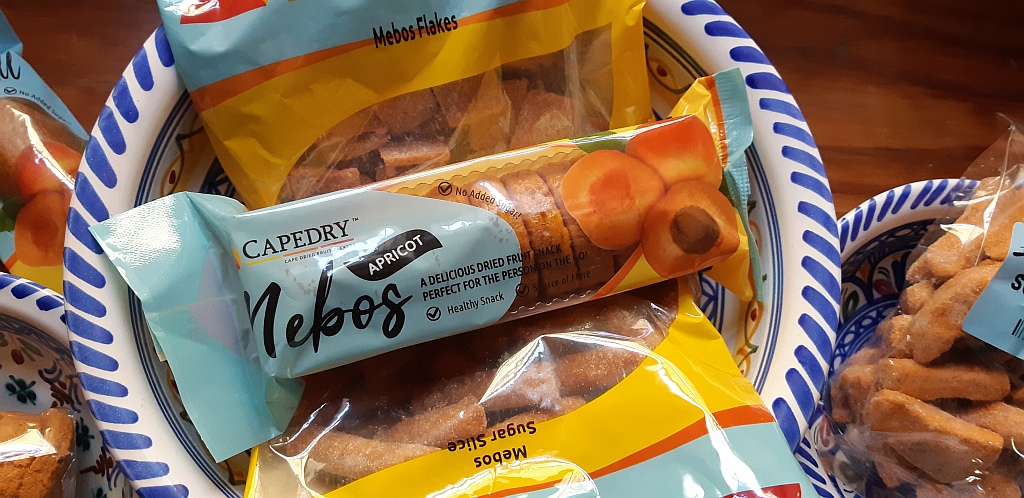
Mebos is made from dried apricots that are pulped and flavoured with sugar and salt. Once flavoured, the apricot pulp is shaped into circles or sticks. Mebos is an acquired taste for most people. The pressed salty sun-dried apricots cover a whole flavour spectrum from salty, sour, and sweet with the unmistakable flavour of apricot. Personally, I prefer the mebos wheels without the sugar.


Dried fruit producers offer mebos in different forms. These vary from the round disks, sticks, flakes, slices, to squares. Normally they are natural flavoured or sugared. The sugar tends to disguise the salty sour taste of the mebos. For me, it is a way of sweetening the experience to capture a broader audience.


What tempted me in Atlas Trading, was a small jar of mebos dip. It turned out to be a versatile dip. It had the flavour of mebos but with a spicy edge. I found the dip great for snacks and I prefer it to sweet chilli sauce.
  One can even use it in a marinade for a leg of pork or a roast chicken.


The name mebos is said to originate from the Japanese word umeboshi and comes from the Prunus Mume, known in Japanese as “ume”. The Prunus Mume is often translated as “Asian plum”, but this fruit is closely related to the apricot. Umeboshi is a brined, fermented sun-dried Asian plum/apricot.


During his travels at the Cape of Good Hope from 1772 to 1775, Carl Peter Thurnberg encountered mebos and compared it with the practice of drying fruit in Japan. In 1862 Lady Duff-Gordon in her letters from the Cape recorded buying mebos. On 15 April 1862 she writes, “I have bought some Cape confeyt’; apricots, salted and then sugared, called ‘mebos’—delicious! Also pickled peaches, ‘chistnee’, and quince jelly.” I can agree with Lady Duff-Gordon. I am sure it was as delicious then as it is now.


In “The story of an African Farm”, written by Olive Schreiner under the pseudonym Ralph Iron and published in 1883, Bonaparte Blenkins, the confidence trickster in the story, illustrated what a liar is by telling the story of a boy from Short Market Street, Cape Town. The boy was sent to buy meiboss (mebos). The boy came back concealing from his mother how many pieces he had bought.

“ “Here, Sampson,” said his mother, “go and buy sixpence of meiboss from the Malay round the corner.”

“When he came back she said: “How much have you got?”

“Five,” he said.

He was afraid if he said six and a half she’d ask for some. And, my friends, that was a lie. The half of a meiboss stuck in his throat and he died and was buried. And where did the soul of that little liar go to, my friends? It went to the lake of fire and brimstone.” “


In the cookbook by Hildagonda J Duckitt, Hilda’s where is it of recipes, first published in 1891, I found the earliest recipe for the making of mebos.

Hildagonda Duckitt's recipe for Mebos
In his book Social Life in Cape Colony in the Eighteenth Century, published in 1926, Colin Graham Botha writes the following, “Apricots were dried and made into “mebos”, no doubt an art learnt from the East, …”


In “In Search of South Africa”, published in 1948, H. V. Morton writes, ”Mebos is not common. Here again we have something that came to the Cape from the Far East. Some believe that the word is derived from the Arabic mushmush, an apricot, but others, and this is more likely, from umeboshi, a Japanese word given to preserved plums. Mebos is made of ripe apricots, dried, salted, and sugared, and the taste is an acquired one, for it belongs definitely to that “sweet and sour” order so palatable to the Chinese. People brought up in China tell me that plums salted and sugared like mebos are still popular there, and it is fairly certain that this unusual sweetmeat came to South Africa in early times by way of the Dutch East India Company’s factories in China and Japan.”


In the Afrikaans folksong “Daar kom Tant Alie” Aunt Miena is cooking syrup from the mebos jam.

“Daar kom tant Alie, tant Alie, tant Alie,
daar kom tant Alie, tant Alie om die draai.

En tant Miena kook stroop van die mebos-konfyt,
van die Wellingtonse suiker teen ‘n trippens die pond,
en tant Miena kook stroop van die mebos-konfyt,
van die Wellingtonse suiker teen ‘n trippens die pond.”


Mebos made from dried apricots are a true Cape tradition. It is well recorded in historical travel writing, popular fiction, folk songs, and historical cookbooks. For the established lover of mebos it will always be a delight.

Apricot blossoms in the orchard
To lure a new and young audience to the taste of mebos, a beverage company on the West Coast of the Western Cape is producing a naturally fermented, preservative free, low sugar, gently sparkling mebos drink. If you are that way inclined, you can inhale mebos vape fluid made by a company in Wellington, South Africa.


I might be tempted to try the mebos drink, but I will pass on the vape fluid. Buying the mebos dip has inspired me to explore the culinary possibilities of mebos, but I am quite happy to sit back and enjoy this tangy salted snack just as it is.


Sources:

Letters from the Cape (1861-62), Lady Duff-Gordon, Published 1925

The story of an African Farm, Olive Schreiner, Published 1883 

Hilda’s where is it of recipes, Hildagonda Duckitt, First Published 1891   

Social Life at the Cape, C.G. Botha, Published 1926

In Search of South Africa, H.V.Morton, Published 1948