Showing posts with label traditional south african food. Show all posts

Friday, 24 September 2021

Mebos musings

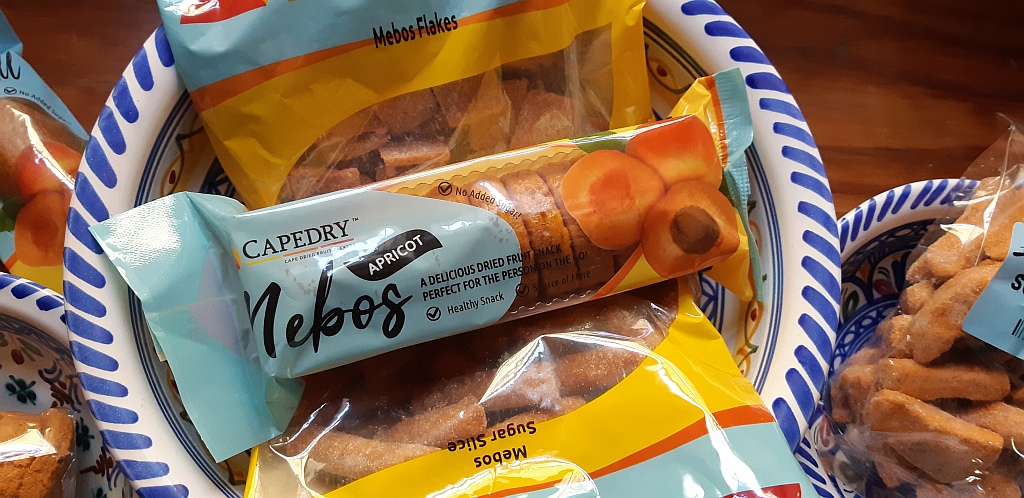
On one of my recent visits to Atlas Trading in the Bo-Kaap, Cape Town, a sign for Mecca Mebos on one of the shelves caught my attention. For me, Mebos is synonymous with the Cape and its dried fruit culture. On closer inspection the packet read, “Dried Apricot Paste”. The ingredients indicated on the pack included apricots, sugar, and olive oil. I was not sure why it was described as mebos, because it was not mebos as I know it.


Mebos is made from dried apricots that are pulped and flavoured with sugar and salt. Once flavoured, the apricot pulp is shaped into circles or sticks. Mebos is an acquired taste for most people. The pressed salty sun-dried apricots cover a whole flavour spectrum from salty, sour, and sweet with the unmistakable flavour of apricot. Personally, I prefer the mebos wheels without the sugar.


Dried fruit producers offer mebos in different forms. These vary from the round disks, sticks, flakes, slices, to squares. Normally they are natural flavoured or sugared. The sugar tends to disguise the salty sour taste of the mebos. For me, it is a way of sweetening the experience to capture a broader audience.


What tempted me in Atlas Trading, was a small jar of mebos dip. It turned out to be a versatile dip. It had the flavour of mebos but with a spicy edge. I found the dip great for snacks and I prefer it to sweet chilli sauce.
  One can even use it in a marinade for a leg of pork or a roast chicken.


The name mebos is said to originate from the Japanese word umeboshi and comes from the Prunus Mume, known in Japanese as “ume”. The Prunus Mume is often translated as “Asian plum”, but this fruit is closely related to the apricot. Umeboshi is a brined, fermented sun-dried Asian plum/apricot.


During his travels at the Cape of Good Hope from 1772 to 1775, Carl Peter Thurnberg encountered mebos and compared it with the practice of drying fruit in Japan. In 1862 Lady Duff-Gordon in her letters from the Cape recorded buying mebos. On 15 April 1862 she writes, “I have bought some Cape confeyt’; apricots, salted and then sugared, called ‘mebos’—delicious! Also pickled peaches, ‘chistnee’, and quince jelly.” I can agree with Lady Duff-Gordon. I am sure it was as delicious then as it is now.


In “The story of an African Farm”, written by Olive Schreiner under the pseudonym Ralph Iron and published in 1883, Bonaparte Blenkins, the confidence trickster in the story, illustrated what a liar is by telling the story of a boy from Short Market Street, Cape Town. The boy was sent to buy meiboss (mebos). The boy came back concealing from his mother how many pieces he had bought.

“ “Here, Sampson,” said his mother, “go and buy sixpence of meiboss from the Malay round the corner.”

“When he came back she said: “How much have you got?”

“Five,” he said.

He was afraid if he said six and a half she’d ask for some. And, my friends, that was a lie. The half of a meiboss stuck in his throat and he died and was buried. And where did the soul of that little liar go to, my friends? It went to the lake of fire and brimstone.” “

In the cookbook by Hildagonda J Duckitt, Hilda’s where is it of recipes, first published in 1891, I found the earliest recipe for the making of mebos.

Hildagonda Duckitt's recipe for Mebos
In his book Social Life in Cape Colony in the Eighteenth Century, published in 1926, Colin Graham Botha writes the following, “Apricots were dried and made into “mebos”, no doubt an art learnt from the East, …”


In “In Search of South Africa”, published in 1948, H. V. Morton writes, ”Mebos is not common. Here again we have something that came to the Cape from the Far East. Some believe that the word is derived from the Arabic mushmush, an apricot, but others, and this is more likely, from umeboshi, a Japanese word given to preserved plums. Mebos is made of ripe apricots, dried, salted, and sugared, and the taste is an acquired one, for it belongs definitely to that “sweet and sour” order so palatable to the Chinese. People brought up in China tell me that plums salted and sugared like mebos are still popular there, and it is fairly certain that this unusual sweetmeat came to South Africa in early times by way of the Dutch East India Company’s factories in China and Japan.”


In the Afrikaans folksong “Daar kom Tant Alie” Aunt Miena is cooking syrup from the mebos jam.

“Daar kom tant Alie, tant Alie, tant Alie,
daar kom tant Alie, tant Alie om die draai.

En tant Miena kook stroop van die mebos-konfyt,
van die Wellingtonse suiker teen ‘n trippens die pond,
en tant Miena kook stroop van die mebos-konfyt,
van die Wellingtonse suiker teen ‘n trippens die pond.”


Mebos made from dried apricots are a true Cape tradition. It is well recorded in historical travel writing, popular fiction, folk songs, and historical cookbooks. For the established lover of mebos it will always be a delight.

Apricot blossoms in the orchard
To lure a new and young audience to the taste of mebos, a beverage company on the West Coast of the Western Cape is producing a naturally fermented, preservative free, low sugar, gently sparkling mebos drink. If you are that way inclined, you can inhale mebos vape fluid made by a company in Wellington, South Africa.


I might be tempted to try the mebos drink, but I will pass on the vape fluid. Buying the mebos dip has inspired me to explore the culinary possibilities of mebos, but I am quite happy to sit back and enjoy this tangy salted snack just as it is.


Sources:

Letters from the Cape (1861-62), Lady Duff-Gordon, Published 1925

The story of an African Farm, Olive Schreiner, Published 1883 

Hilda’s where is it of recipes, Hildagonda Duckitt, First Published 1891   

Social Life at the Cape, C.G. Botha, Published 1926

In Search of South Africa, H.V.Morton, Published 1948

Saturday, 19 June 2021

The History of Koeksisters explained

After efforts towards finding information about the origins of Koeksisters in my traditional South African cookbooks, I recalled Hester Wilhelmina Claassens’ thesis for her doctorate written in 2003, “Die Geskiedenis van Boerekos 1652-1806”. A shortened version of this thesis was published in a book of the same title in 2006.


In her thesis, “Die Geskiedenis van Boerekos 1652-1806” (2003), Hester Wilhelmina Claassens explains the origins of the Koeksister, Koesister and Bollas.

She writes that the most popular cake in 17th century Holland was “stroopkoek” (syrup cake). From literary descriptions, it seems that the “stroopkoek”and “oliekoek” (oilcake) was the same thing. The recipe for oliekoek in the “De verstandige kock (1668)” contained raisins, apples and almonds, apart from the cinnamon, cloves and ginger. The dough was fried in deep fat and then rolled in a “syrup”. The syrup that was used to dip the dumplings was not a liquid but only melted sugar. Oliekoek was called (Olie)Bolle at the Cape. In the old Cape recipe manuscripts, the Malay people used to refer to Bolle or Bollas. These recipes are the same as an original Arabian recipe.


My further research on the subject suggests that the Arabian recipe appears to have come to Andalusia (Southern Spain) during its dominant Muslim period (roughly 700 -1200). When Spanish rule came to the Southern Netherlands and neighbouring territories in the period 1556 -1714, the recipe most likely came with and became part of the Dutch culinary tradition. This tradition then followed the Dutch to their colonies in the east, Batavia and other territories like the Cape.

(See an Arabian recipe from the 13th Century in my post Koeksisters, Koesisters and Bollas.)

In Hilda Gerber’s “Traditional cookery of the Cape Malays”, she shares a recipe of Mrs Galiema S., off Hanover Street, Cape Town. It is a recipe for cinnamon flavoured, sugarless “Bollas” that was not dipped in syrup. The dough for Bollas is rolled out and pressed in round forms. According to Mrs Galiema, these Bollas were enjoyed for breakfast on Sundays instead of Koeksisters. A custom that continues today in some homes.

Traditional Cookery of the Cape Malays [Hilda Gerber]
The earliest recipe for Bolle Claassens could find was in the Versfeld manuscripts, circa1800. In the Cape, the Bolle that was not dipped in sugar or syrup was known as “Vetkoek” because it was mostly fried in fat.

According to Claasens, the recipe for Crullers that became koeksisters at the Cape, dates to the 15th century cook Martino, the head cook of the Holy Patriarch of Aquileia. He used sliced dough to make Crespelli (now called Cenci). He explained that the dough could be plaited or turned in any form before it is baked in fat. After it was baked it was sprinkled with cinnamon sugar. Crullers that are plaited like koeksisters and dipped in sugar and not syrup can be found in Europe and Scotland.

Aberdeen Crulla, German Crullers, Danish Klejne, Bugnes de Lyon and Fattigman

One can find the resemblances in the Aberdeen Crulla, Danisk Klenje, German Crullers, Swedish Fattigman and many more.

In the Cape, some confusion originated when the same dough started to be used for the ”Oliebol” (without the fruit) and the Cruller. According to Claassens’ thesis, it is not clear when the same dough first began to be used for the different confectionaries.

Claassens notes the fact that the same dough was used for “Oliebolle” and Crullers/koeksisters. This is also clear from Mrs Galiema’s words in Hilda Gerber’s book “Traditional Cooking of the Cape Malays”: "Make Bollas exactly like Koesisters, but add cinnamon." To add to the confusion, plaited Crullers started to be called Koeksisters.


Claassens has a very interesting explanation for the origin of the name Koeksister,

“Die oorspronklike Kaapse benaming koeksusters - vir gevlegte krullers - se oorsprong lê waarskynlik by die koeke genaamd Groote zuster, Kleine zuster en Kuische Zuster. Dié resepte het in De volmaakte Hollandsche keuken-meid (1761) en waarskynlik ook in die eerste uitgawe in 1746 verskyn. Dit is moontlik dat die naam koeksuster wat vir die gevlegte vorm meer beskrywend as kruller was, na aanleiding van die name van bogenoemde koeke ontstaan het. Die meeste kokke het die deeg vir koeksusters in drie repe  verdeel om te vleg. Die drie repe is moontlik met die name van bogenoemde drie koeke verbind en daarom is daarna as koeksusters verwys. Sinkopee van die [k] aan die einde van die eerste lettergreep en die ontronding van die [u] in die tweede sillabe van die woord, was te wyte aan sowel slordige uitspraak as Engelse invloed. Van Dale se Handwoordenboek der Nederlandse taal het nie 'n woord soos "sister" nie, en volgens Verdam se Middelnederlandsch handwoordenboek, is die vorms "sister, zester, sester" gebruik om 'n inhoudsmaat aan te dui en kan dit dus buite rekening gelaat word as betekenisdraer in 'n vorm soos koeksister wat vandag deur baie mense as die oorspronklike naam beskou word.

Volgens die Etimologiewoordeboek van Afrikaans is sister in die samestelling koeksister, moontlik 'n vervorming van sisser wat verwys na die geluid wat die deeg in die kokende olie maak. Dit is egter onwaarskynlik dat sprekers in die omgangstaal 'n maklike uitspraak met 'n dubbele [s] sal verruil vir 'n ingewikkelder uitspraak waar die stand van die tong van [s] na 'n sluitklank [t] moet verander. Aangesien Groote zuster, Kleine zuster en Kuische zuster se resepte op die vroegste net voor die middel van die agtiende eeu kon verskyn het, moes die benaming koeksuster eers daarna in gebruik begin kom het. Voor daardie tyd is die Hollandse naam cruller waarskynlik gebruik. Die feit dat die verwarring met die benaming tot byna die helfte van die twintigste eeu voortgeduur het, dui moontlik daarop dat die naamsverandering eers laat in die agtiende eeu begin het.”

Loosely summarized, Dr Claasens’ research findings on the subject are that the name Koeksister, for what was essentially a braided Dutch Kruller, apparently originates from three variants of the Kruller published in a Dutch recipe book in 1746 and again in 1761. These variants were known as Groote Zuster (Big Sister), Kleine Zuster (Small Sister) and Kuische Zuster (Chaste Sister). The common fundamentally dominant elements of these recipes make up the recipe for the Koeksister. The three braids reference the three sister cakes. Dr Claasens also unpacks the etymology of the sister portion of the name Koeksister.


Dr Claassens' thesis is interesting and professionally researched. It is a must-read for anybody interested in the culinary history of South Africa. It is a pity that it is only available in Afrikaans. If more people knew about her research and explanation of the origin and name of the koeksister, there might be less need for speculation on the subject.


Sometimes people prefer not to know the researched academic explanation of things and find comfort in the oral history and mystical legend of the familiar.

Source: Die geskiedenis van Boerekos 1652-1806 - Claassens, Hester Wilhelmina, Thesis (DPhil)--University of Pretoria, 2005.

More posts about Koeksisters on this blog.

Koeksisters, Koesisters and Bollas

Koeksisters en Koffie (Afrikaans)

Dried naartjie peel

Wednesday, 16 June 2021

Koeksisters, Koesisters and Bollas

During lockdown, I started browsing the internet for rare and secondhand books. I hoped that this activity would help me overcome the longing brought about by not being able to browse through secondhand bookshops, a favourite pastime. I love books and enjoy the excitement of coming across a bargain rare book. Nothing beats a bookshop with shelves laden with books from floor to ceiling.

To be in the presence of so many books, to see and smell them, is the best therapy. I can lose myself in their pages. Knowing that I will find something there that will fascinate me. I have never been able to walk into a bookshop and not walk out without a handful of books.


Browsing the internet for books is extremely dangerous where I am concerned. I was able to fill several ‘Wish Lists’ in no time. Emails reminding me that I have books waiting in ‘Wish Lists’ are frequent. No, I do not need help completing the purchase, I need help not to make the purchase.


On one of my online shopping excursions, I came across two books by Betsie Rood that I wanted to add to my Towerwater collection of traditional South African cookbooks.
“101 Traditional South African Recipes” and “Malay Cooking”, is in my opinion an essential part of any South African traditional cookbook collection.


In “101 Traditional South African Recipes” published in 1977, she has selected 101 traditional South African treasured family recipes from scrap books that date back to the 1890s. These traditional recipes she inherited from her mother and mother-in-law, and both her grandmothers.


“Malay Cooking”, published in 1978, was first published a year earlier, in 1977, in Afrikaans as “Maleierkookkuns”. To my knowledge, this cookbook was the first to be published in Afrikaans about Malay cooking. The book is more of a recording of popular recipes used by Malay cooks. Each contributor’s name appears alongside her recipe. Interestingly, where cooks had differing approaches to a specific recipe, the different recipes for the same dish are included.


Reading through the two cookbooks, I came across a recipe each for koeksisters and koesisters. I was interested to find the recipe for the plaited koeksisters in “101 Traditional South African Recipes” and the round koesister rolled in desiccated coconut, in “Malay Cooking”. The contribution of Malay cooks to traditional South African cooking is indisputable.

This got me thinking about the name koeksister/koesister and how it came about that the same name was used for two quite different confectionaries, but also interchangeably.


The origin of the koeksister is not exactly clear, but it is popularly thought to have originated from a recipe brought to the Cape by Dutch settlers in the 17
th century.

After reading several online speculations about the origin of both koeksisters and koesister, it was clear that none of these really knew the origin. I decided to consult my collection of South African cookbooks after searching online unsuccessfully for possible Dutch recipes for any confectionary resembling the two. In the Dutch cookbook “De Verstandige Kock,” published in 1667, I could not find any recipe resembling either of the two Cape recipes. I deduced that the recipes could both have roots in Middle Eastern or Asian recipes. Further, that the recipes in their current form were not traditionally Dutch which would explain why they were not included in this cookbook. Or, at best, that something familiar in the Dutch tradition had evolved into a new guise.


The South African cookbooks I consulted were “Cape cookery” by A G Hewitt published in 1889, “Hilda's where is it of recipes” by
 Hildagonda Duckitt published in 1891,  “Di Suid-Afrikaanse kook-, koek- en resepte boek” by E J  Dijkman published 1890, “Die praktiese kookboek vir Suid-Afrika”  by S van H Tulleken published 1937, “Traditional cookery of the Cape Malays” by Hilda Gerber published in 1954, “The South African Cullinary Tradition” by Renata Coetzee published in 1977,  “101 Traditional South African Recipes” by Betsie Rood published in 1977 and “Malay Cooking” by Betsie Rood published in 1978.


A G Hewitt recorded a recipe for Kosiesters. The recipe is clearly for the ‘Malay version’ of koeksisters but does not mention any coconut. Hildagonda Duckitt recorded a recipe for Koesisters which is annotated as “Batavian or old Dutch Recipe”. However, the recipe looks like that of the plaited koeksister. The recipe calls for the dough to be rolled out and cut into strips but there is no specific mention of plaiting. Did Hilda merely assume her audience would know this? E J Dijkman recorded a recipe for Koesisters that also resemble the plaited one. However, it calls for the rolled dough to be cut in squares before frying. These recipes remind one of the Italian Chiacchiere and Cenci.

Chiacchiere, Image source:Wikipedia 

Hilda Gerber (1954) recorded a recipe for Koesisters that is clearly the ‘Malay version’, but here I found the addition of rolling it in grated coconut. Renata Coetzee recorded a recipe for Koeksisters that is clearly for the plaited variety and here I notice the addition of buttermilk or sour milk to the dough mixture.


In her book “Malay Cooking”, Betsie Rood records two recipes for Koesisters and one for Potato Koesisters but she adds a recipe for Bollas. The Bollas are made like Koesisters but the dough balls do not get rolled in sugar or coconut. Potato Koesister apparently is only made by more skilled cooks, but it makes for a fluffier koesister. In her book “101 Traditional South African Recipes” Betsie Rood recorded a recipe for the plaited Koeksisters.


From all the above, it is evident that historically, the name koeksister and koesister were used interchangeably for any version of the sweet confectionary. It depended on the person recording the recipe. To add further evidence to this observation, there is a historical advert outside a shop in the Bo-Kaap (the historic Malay Quarter of Cape Town which has origins going back to the earliest years of the settlement at the Cape), advertising koeksisters with an image of the ‘Malay koesisters’ rolled in desiccated coconut.

I decided to look at historical recipes from Asia and the Middle East that might have influenced and informed the confectionaries that has become so uniquely South African.


When I investigated the plaited koeksister, I found a 13
th century Arabian recipe recorded in Andalucía, Spain, for Dafâir or Braids. Dafâir or Braids is deep fried and then covered in a syrup.

Dafâir/Braids, Fried Dough Twist and Jalebi

“The Making of Dafâir, Braids

Take what you will of white flour or of semolina, which is better in these things. Moisten it with hot water after sifting, and knead well, after adding some fine flour, leavening, and salt. Moisten it again and again until it has middling consistency. Then break into it, for each ratl (ratl shami = a medieval Middle Eastern unit of measurement for both liquid and mass which could be approximately 2,88kg in this context) of semolina, five eggs and a dirham (an ancient Middle Eastern unit of measurement roughly equivalent to 3,1g) of saffron, and beat all this very well, and put the dough in a dish, cover it and leave it to rise, and the way to tell when this is done is what was mentioned before [it holds an indentation]. When it has risen, clean a frying pan and fill it with fresh oil, then put it on the fire. When it starts to boil, make braids of the leavened dough like hair-braids, of a handspan or less in size. Coat them with oil and throw them in the oil and fry them until they brown. When their cooking is done, arrange them on an earthenware plate and pour over them skimmed honey spiced with pepper, cinnamon, Chinese cinnamon, and lavender. Sprinkle it with ground sugar and present it, God willing. This same way you make isfunj, except that the dough for the isfunj will be rather light. Leave out the saffron, make it into balls and fry them in that shape, God willing. And if you wish stuffed dafâir or isfunj, stuff them with a filling of almonds and sugar, as indicated for making qâhiriyât.” Source: An Anonymous Andalusian Cookbook of the 13th Century

Oliebolle, Mahua and Lokma
I found several twisted deep-fried foods from Asia that might have influenced the South African koeksister. “The Small Honey Fried Dough Twist”, Chinese Mahua, Jalebi and Lokma are some examples.


Koeksisters, koesisters and bollas have become part of the South African culinary identity. Naturally, Koeksisters and Koesisters often put in a welcome appearance for tea at Towerwater. Whichever one you prefer, one will not find anything more South African no matter the roots of origin.

More posts about Koeksisters on this blog.

The History of Koeksisters explained

Koeksisters en Koffie (Afrikaans)

Dried naartjie peel

Thursday, 9 April 2020

Grape must and mosbolletjies*


*A traditional Cape wineland brioche

With the final picking of Muscat d’Alexandrie (Hanepoot) grapes for the season from the garden, I decided to make a must for traditional must buns (mosbolletjies). Mosbolletjies are a type of brioche traditionally made in the Cape winelands. I would also have liked to have made some must grape syrup (moskonfyt) but had to save that thought for another year. Moskonfyt, requires much more must as it takes five litres of must to make a reduction of one litre of moskonfyt. The late picking would produce enough must for two bakings of mosbolletjies, but not enough for moskonfyt.


The making of authentic traditional Cape mosbolletjies was envisaged years ago with the planting of a row of Hanepoot grapes, alongside the vegetable garden. Nowadays, food rarely has a seasonal identity. Everything is of course available throughout the year. As in the case of mosbolletjies that are available on shop shelves no matter the season. Few know the pleasures of eating in season, in harmony with nature.


I am certain that most mosbolletjies found on shop shelves have never seen must. Not even of the sort made from seeded raisins, which can be produced out of season. This sort of mosbolletjie is but only so in name.


Traditional mosbolletjies were an authentic Cape wineland seasonal treat. Available only during the grape pressing of the wine-making season (late summer to early autumn). Freshly available must was the perfect moment for the preparation of the mosbolletjie treat. Mosbolletjie rusks were also made at this time, for tomorrow’s pleasure. Such rusks could be enjoyed when one might be overcome by the longing memory of a shiny headed fresh mosbolletjie, whilst the next pressing season remained a blip on the distant horizon.

We have forgotten how everything had its time. How half the pleasure in a delectable seasonal treat lay in the indulgent memory of it. The memory would come to rest on your palate as you longed for the approaching season. The aromas of must, flour and aniseed that would fill the kitchen like long last seen loved ones on a visit.


And as the full-blown pan of buns emerge from the oven, all the joys of yesteryears seasons rush up fresh and warm in an instant. It is as though all your wellbeing is suspended in the joy of a single warm mosbolletjie.

For me, to be able to make mosbolletjies from our own home grown Hanepoot grapes, was a special pleasure. But even greater, is the memory of favourite traditions and the opportunity to relive them.

To make mosbolletjies, I had to start with the making of the must. That is where one begins with the making of mosbolletjies. This meant that I had to learn how to make the must. Recipes for the making of traditional mosbolletjies are plentiful, but the authors clearly assumed that you had a ready source for the must. Yes, in the Cape, sourcing must would not be a challenge in bygone times. Everyone knew someone on a wine farm, with a generous heart who would willingly donate a jug or two of fresh must.

Fresh Hanepoot grape berries, Hanepoot juice, fermenting Hanepoot must, fresh bottled must
So begins our mosbolletjie journey, with a picking of five kilograms of Hanepoot grapes. Wash the grapes and pick off the berries from the bunches into a bucket. Press all the juice from the berries. I used my hands to squash the berries, without damaging the seeds. It sounds easier than it is. One must press and rub in order to extract all the juice. When all the juice has been extracted, loosely cover the bucket with a lid. Place the bucket in a warm place and let rest for two and a half days. The must is ready when the squashed berries float to the surface and a froth begins to form. Don’t let your must ferment for too long. You will lose the sweetness (sugar levels) and the must will begin to turn to wine.

Sifting flour, adding must, flour covering with cracks, the dough
With the must now ready, I only had to find an appropriate recipe to make the mosbolletjies. After studying all the historical recipes at our disposal, we decided on a combination using those from the cookbooks, Om die tafel in ou Stellenbosch, published in 1987, and Old-Time Recipes, published in 1952.

Towerwater Mosbolletjies

Ingredients:
2.5kg Strong cake flour
1t (5ml) Salt
1 Tbs (15ml) Aniseed
3 cups (750ml) Hanepoot must
1 cup (250g) Butter
2 cups (400g) Sugar
2 cups (500ml) Milk
2 Eggs

Method:
Sift the flour into a mixing bowl, reserving about half a cup full in the sieve. Sprinkle over the salt and aniseed. Make an indentation in the centre of the flour and pour in the must. Sift the flour reserved in the sieve over the must to form a covering. Set the mixing bowl in a warm place for an hour until some cracks form in the flour covering.

Melt the sugar and butter over a low heat. Allow to cool until warm. Warm the milk and add to the butter mixture.  When cool enough, beat the eggs into the mixture. Add this mixture to the flour and knead well. Brush some melted butter over the dough, cover and set aside to rise overnight. Next morning, break the dough into equal sized buns of about 100g each. About 44 buns should be possible. Pack the buns closely together in pans. Allow to rise to double their size. The length of time will be determined by the warmth. Brush the risen buns with tepid milk. Bake for an hour at 180°C. Remove from oven and let cool.


To make mosbolletjie rusks, separate the buns from each other and cut each into four pieces. Dry the pieces at 100°C for 4-6 hours or overnight in a warming drawer.


Keith managed the making of the dough, buns and the baking. I was therefore the brewer and he, the baker. Together we made authentic traditional mosbolletjies. From the grapes on the vine, to must, dough and ultimately freshly baked mosbolletjies, was indeed an authentic Towerwater experience.

The question remains. Are mosbolletjies made without must really mosbolletjies? Surely, a more appropriate name for mosbolletjies without must, should be aniseed buns. After all, that would be the principle ingredient lending identity to the bun.


Kliek hier vir die Afrikaanse weergawe - Mos en mosbolletjies