Showing posts with label country house. Show all posts

Tuesday, 18 August 2026

Celebrating Tradition, Limewash and History

There is something about limewashing an old house that makes you feel you are participating in a ritual rather than simply doing maintenance.

As winter begins to loosen its grip and the first promise of spring appears along the Breede River, we find ourselves looking at the old buildings of Towerwater with a slightly different eye. The winter rains have left their marks. The walls have softened in colour, the edges have gathered a little dust and weather, and here and there the old limewash has begun to show the years beneath.

It is time to limewash, and it is not glamorous work. There are buckets, brushes, splashes on the ground and white fingerprints everywhere. There is the particular smell of wet lime, earthy and clean, and the constant business of stirring the mixture because limewash has a mind of its own. It settles, separates and demands to be woken up again.

But once the first brushful goes onto an old wall, something happens. The building begins to come alive.

At Towerwater, this is especially moving because the walls are not merely walls. They carry the marks of the people who built them, repaired them, leaned against them, swept their floors and opened their doors to the seasons. They are made in the old Cape way, of earth, clay, stone, lime and all the imperfect materials that belonged to a time when a building was made from what could be found nearby.

You can feel that history in the surface. A modern wall wants to be smooth and perfect. An old wall has no such ambition. It bows slightly in the afternoon light. It carries a little unevenness beneath the brush. There are places where the plaster is thicker, places where the earth beneath seems almost to breathe through the surface, and small repairs that tell their own quiet story.

Limewash suits such walls. It doesn't try to conceal them. It settles into their imperfections and makes them beautiful.

There is something wonderfully old-fashioned about watching a white wall appear beneath a brush. The colour is almost startling when it is wet, grey and cold, but as it dries it becomes softer, chalkier and warmer. The rough places catch the light. The old pebbledash takes on a new life, each little stone showing itself for a moment before becoming part of the whole again.

And then there is the sun. The Cape sun has always had a way of making white buildings glow. On a late winter morning, freshly limewashed walls can seem almost too bright to look at. By afternoon, the light has softened and the buildings settle back into the landscape: white against the green, old walls beneath blue sky, the whole place looking somehow both freshly renewed and exactly as it ought to be.

Perhaps that is what I like most about limewashing. It is renewal without erasure. You don't scrape away every trace of the past. You don't try to make an old building look new. You simply give it another coat, another season of protection, another chance to face the weather.

And underneath the new limewash are all the earlier layers. Somewhere beneath our brush are the coats put on by hands long gone. There may be limewash from decades ago, perhaps repairs made by people whose names we will never know. The wall has been whitened before, and before that, and before that.

We are only adding our own thin layer to the story. There is a rhythm to the work, dip the brush, let the excess run back into the bucket, brush across the wall, step back, look, move the ladder, start again.

After a while, you stop thinking about the work itself. You notice the sounds around you: the birds, the wind moving through the trees, perhaps a tractor somewhere in the distance. You notice how the morning becomes warmer. You notice the smell of the earth after rain.

And occasionally, you stop altogether. Because standing in front of an old Cape building with a brush in your hand is a curious way of understanding time.

The people who built these places knew that buildings needed looking after. They did not expect walls to remain untouched. Limewash was part of the life of the house. It was maintenance, protection and appearance all at once.

The walls are renewed, ready for a new cycle of seasons. In a world increasingly obsessed with making things permanent, limewashing reminds us that some things are meant to be renewed.

The old walls don't resist it. They accept the fresh lime quietly, just as they have accepted the rain, the dust, the heat and the years. By the time we finish, the brushes are tired, our clothes have acquired their own white decorations, and there is lime on places where lime was never intended to be. But the buildings look wonderful. Not new, never new, just cared for.

The late-winter light catches the freshly whitened walls, and for a little while Towerwater looks as though it has stepped out of an old photograph: white gables, rough walls, green trim and that particular Cape brightness that seems to belong to another age.

Then the wind comes up from the river. The trees move. A bird calls from somewhere beyond the buildings, and we put the buckets away until next time. Because that, too, is part of the tradition.

The old buildings endure, not because time has left them untouched, but because generation after generation has taken the trouble to care for them in the traditional way. And there is something rather comforting in knowing that, for one small part of their long history, we have done the same.

Monday, 1 March 2021

The reality of dreams

Thirty years ago, to the day, we took ownership of a neglected property at 25 Church Street, Bonnievale. We were young. Everything was possible if one was prepared to work hard, make sacrifices, and be prepared to compromise. We still had to discover the price one pays for dreams.

The start of a dream. Large vegetation and rubbish removed.
We came to the realization that the town did not see the house as we did. When Keith personally submitted our building plans for the house, he was told that a demolition permit was a much cheaper option. The senior representative of the local municipality advised him to save his money and take the demolition permit. He declined the generous offer.

Saving the cottage. One hole taking 120 bricks to fill.
First clean-up about to start.
Love at first sight, or a moment of madness.
We had little money, but lots of energy and great dreams. We loved the old buildings. To us, seeing the cow-dung floors, reeded ceilings, wall cupboards, brandsolder and other indicators of much older buildings, were like reading poetry. The house only needed some editing to help others see what we saw.

Clearing begins and the house breathes again.

From the word go, we never saw the present reality before us. Instead, we always saw our dream. We were determined to realise that dream. We were very purist in our approach to restoring the old buildings. We loved Cape vernacular architecture in its purist form. White walls, thatched roofs, painted woodwork and clay floors. The property in Bonnievale was begging to be restored to its former glory.

The first consignment of 16 tons of stone to rebuild missing sections of the terrace wall.
When we bought the house, we found that the configuration had been changed. Somewhere in history, the front had become the back and vice versa. It had a 1960’s stoep added with large steel framed windows. In fact, almost all the windows had been replaced with steel frame windows. Mostly, fortunately, conforming to the original openings.

Renovated cottage. This should keep it standing until restoration starts.
Basic renovations complete. Enclosing the property begins.
A celebratory moment. Enclosed and renovated.
We bought the house as is, with most of the furniture and contents of the loft included. The property had no fences. Portions of the property had been sold off only a couple of years before.  The buildings needed serious intervention. The vegetation had to be brought under control as parts of the buildings were suffocated by under- and overgrowth.

Restoration of the cottage.
The house had been standing empty for a couple of years. As it is with vernacular buildings built with sunbaked bricks, it only takes a couple of heavy winters before neglected and exposed brickwork starts melting.

Home-made. Three sets of double gates, two single gates, hundreds of pickets, thousands of screws.
We realised that we had to stabilize the buildings urgently. A two-phased approach of first, renovation and then restoration, was called for. At the first opportunity we renovated the buildings. We kept to the external colour scheme of ochre and blue for the renovation stage. Saving the white, green and thatch for the final restoration phase.


Keith did a lot of the building work himself. From stone walls, garden walls, hearths, and chimneys. He made every picket by hand as well as all the gates.

Rosarium planted. Innovative automated irrigation system using canal water installed.
It works!

We were excited by every step of the renovation and subsequent restoration. The fact that we did it over a long time with spare cash and most of our available free time, meant that the decisions we made were better informed and ultimately benefited the house and us in the end.

Restoration and garden layout and planting complete.

We still have many projects at Towerwater that need to be completed. But, we are 95% there. There will always be details that we will want to improve.

Keith and a smiley Wolfgang take a moment to enjoy country life.
Planting and nurturing trees upfront for entertaining beneath 30 years later.
Looking back over thirty years, we must admit that we enjoyed every part of the process. The heartwarming as well as the heartbreaking bits.

Sticking out our necks to realise a dream.
Today, we have Towerwater to enjoy as the reality of our dreams. Friends and family have been an important part of this journey with us. Their insights and perspectives throughout the process have added a rich fabric to our lives.

 A settled country life dictated by the seasons.

We thought we were restoring Towerwater, but we discovered that Towerwater was in fact restoring us. 


More blog posts on the restoration of Towerwater:


Thursday, 20 December 2018

Vernacular building skills and plaster mixes

Owning a house that is nearly 200 years old means that one needs to do constant maintenance. I believe the true test of whether one is compatible with a historical building, is the measure to which one is prepared to learn traditional skills. Before undertaking the task of restoring your own historical building, one needs to research the building skills and materials of the period in which the building was built. Building practice has evolved immensely over the last century, making contemporary building practice largely incompatible with old buildings. It is often best to consult a professional.

The kitchen gable missing a piece of strap moulding
Most old buildings in the Cape were built with natural materials such as stone, and relatively soft sun-baked bricks, lime plaster and clay. Concrete and strong mixes of cement mortar are usually incompatible with 19th and early 20th century rural Cape building material. If one uses the wrong mortar mix on an old building, it often leads to cracking, uneven settlement and general permeability and adhesion problems, amongst others.

Tools of the trade
Visiting historical buildings many years ago with renowned restoration architects like Dirk Visser and Gawie Fagan was, and remains a privilege in terms of the insight the experience provided. Their passion for this built heritage prepared us for a life of loving old buildings and caring for them.

Keith repairing the inside of the chimney cowl
Restorers generally use a softer mix of lime plaster. The precise ratio may vary from one restoration specialist to another. We have found that a mix of 8 parts sand, 2 lime and 1 cement has worked well on the restoration of Towerwater which commenced 27 years ago.

Preparation
Plastering
When a piece of strap moulding came loose on the kitchen gable-end at Towerwater, it was time to do some maintenance on the ‘old lady’. Luckily Keith, quite unrelated to his profession, is also a skilled plasterer. The greatest challenge was to create a secure working space for him on the steep thatched roof. The top of the gable is very high and one needs to be sure of foot to rule out the risk of serious injury.

Floating the plaster
I am not sure that our measures undertaken to creating a secure working environment for the repair of the moulding would have passed modern building safety regulations. But, we employed a tried and tested vernacular solution for a vernacular repair problem.

Repair work complete
Plastering is a skill that Keith learnt as a young boy. I am always amazed at how effortless he can make it look. In no time the strap moulding was repaired. When it was properly dry, it could be lime washed.

Repair work limewashed
With Keith’s plaster skills and a plaster mix that has stood the test of time at Towerwater, the main house was soon sporting a fresh looking strap moulding. One realises at moments like this how important it is to have the right skills and knowledge to not only restore a historical vernacular building but to maintain it as well. After all, such skills and/or knowledge, would have been commonplace among home owners in centuries past.

Tuesday, 30 August 2016

A fragile architectural heritage

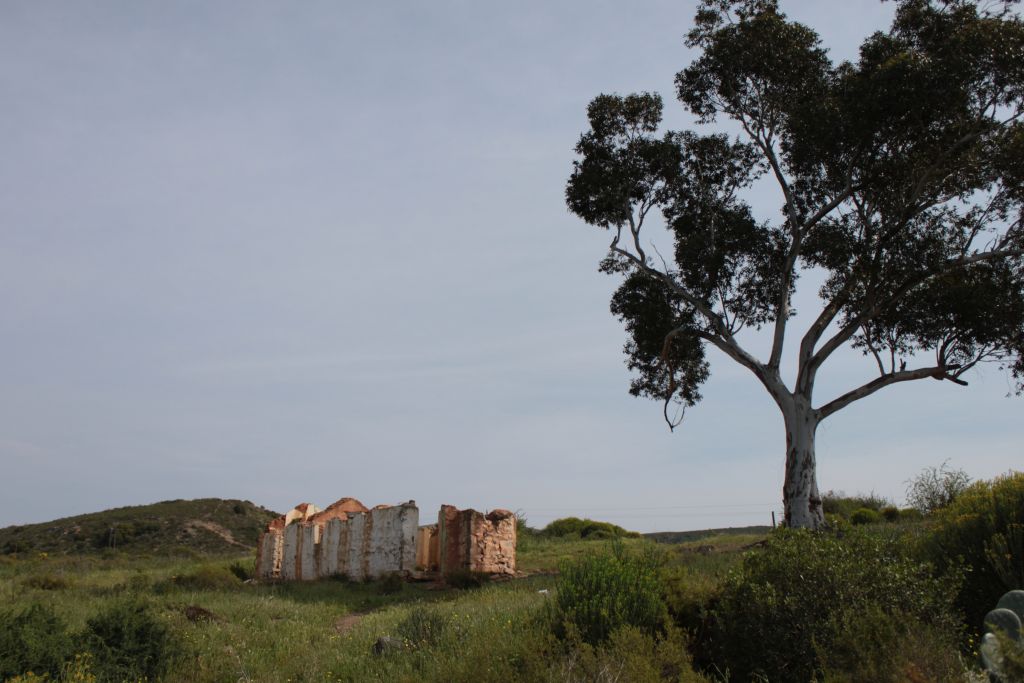
On our trips into the Western Cape country-side we are often saddened by the decay of some clearly architecturally important but minor buildings in the landscape.


We were equally excited by some of the buildings that were maintained in a traditional style. There were even buildings being restored that to our knowledge had been standing empty and derelict for more than 20 years. To see a double storey, five-bay, flat-roofed Cape Georgian farmhouse being restored, must be one of the most exciting sights in the local landscape. From personal experience I know how difficult it is to get information that can assist a person to restore a traditional building in South Africa.


Some European countries have a rich culture of recording their building styles and methods. These can be used as a good guideline but the fact remains that they often have different building methods, materials and climatic conditions to our own.


In our restoration of Towerwater, we were lucky to have access to some of South Africa’s leading authorities on the subject through our lengthy membership dating back to the mid-1980’s and my chairmanship of the Vernacular Architecture Society of South Africa.


Under their learned guidance we have implemented restoration practices starting more than 30 years ago that has served us well up to now on our three heritage properties. There has been no reason to doubt their knowledge and experience then or now as these buildings can attest.


We have also consulted with local traditional builders and craftsmen who were richly experienced in the methodologies of a bygone era. These inputs were particularly relevant to immediate regional specific traditions.


The purpose for which the buildings were originally built also played an important part in our approach to their restoration. The outbuilding that had formerly been a cottage had been turned into a garage by the time that we acquired the property.  We discovered first-hand recollections of when the building had been used as a cottage by the family. This information was to assist the restoration.


I believe that the unavailability of information on restoration practice for the owners of vernacular buildings is detrimental to the preservation of our built heritage. It is simply not economically viable to employ professionals in the restoration of a modest building. Owners when frustrated through the lack of relevant information are more inclined to demolish entirely and rebuild in contemporary material and technologies.


In the countryside, we see old vernacular buildings disappearing on a weekly basis. It is heart-breaking to see these building erased from the landscape. The cultural built landscape is changing at a rapid pace, and in my opinion, undermining the essence of the rural Cape.


The humble vernacular buildings that James Walton OBE encouraged others to record and study are unfortunately the very ones that are disappearing. The consequence is a great loss to our built architectural heritage.


The question remains, how we can encourage owners to conserve these buildings. The owners cannot always afford to employ the services of professionals. In many cases, it is simply a matter of sympathetic maintenance that is required. My suggestion would be to produce guidelines on maintenance and the restoration of vernacular buildings so as to enable enthusiastic owners of simple cottages and outbuildings to conserve them. Our biggest obstacle in the restoration of Towerwater was the absence of available information and constrained finances. Our passion made up for these deficits. Our approach was to undertake the work on a spare cash, spare time basis. We had the luxury of time on our side, something that all owners do not have. Time allowed us to research and source material as the restoration progressed. Unfortunately one does not always find all the relevant information at the outset of the restoration, but as the work progresses one chances upon contextual and valuable information specific to the project.

After publishing our restoration report, fresh information started finding us. While initially we were searching for the information, years down the line, it is now the information that tends to find us. Surely the legacy of our local heritage contains valuable information and practices that have ensured the survival of these buildings over the last 200 – 300 years. If these tried and tested practices are now found to be outmoded, one would be hard-pressed to justify embarking on practices foreign to this legacy in the absence of the efficacy of those methods over an equivalent length of time in this Cape of storms.

My plea is that if there is anybody out there who is not driven by motives other than a passion for the preservation of our unique built heritage, then they will hopefully respond with a layman’s guideline for the maintenance and restoration of simple Cape buildings. The sharing and bedding down of user-friendly methodologies can only augur well for the future.