Showing posts with label limewash. Show all posts

Tuesday, 18 August 2026

Celebrating Tradition, Limewash and History

There is something about limewashing an old house that makes you feel you are participating in a ritual rather than simply doing maintenance.

As winter begins to loosen its grip and the first promise of spring appears along the Breede River, we find ourselves looking at the old buildings of Towerwater with a slightly different eye. The winter rains have left their marks. The walls have softened in colour, the edges have gathered a little dust and weather, and here and there the old limewash has begun to show the years beneath.

It is time to limewash, and it is not glamorous work. There are buckets, brushes, splashes on the ground and white fingerprints everywhere. There is the particular smell of wet lime, earthy and clean, and the constant business of stirring the mixture because limewash has a mind of its own. It settles, separates and demands to be woken up again.

But once the first brushful goes onto an old wall, something happens. The building begins to come alive.

At Towerwater, this is especially moving because the walls are not merely walls. They carry the marks of the people who built them, repaired them, leaned against them, swept their floors and opened their doors to the seasons. They are made in the old Cape way, of earth, clay, stone, lime and all the imperfect materials that belonged to a time when a building was made from what could be found nearby.

You can feel that history in the surface. A modern wall wants to be smooth and perfect. An old wall has no such ambition. It bows slightly in the afternoon light. It carries a little unevenness beneath the brush. There are places where the plaster is thicker, places where the earth beneath seems almost to breathe through the surface, and small repairs that tell their own quiet story.

Limewash suits such walls. It doesn't try to conceal them. It settles into their imperfections and makes them beautiful.

There is something wonderfully old-fashioned about watching a white wall appear beneath a brush. The colour is almost startling when it is wet, grey and cold, but as it dries it becomes softer, chalkier and warmer. The rough places catch the light. The old pebbledash takes on a new life, each little stone showing itself for a moment before becoming part of the whole again.

And then there is the sun. The Cape sun has always had a way of making white buildings glow. On a late winter morning, freshly limewashed walls can seem almost too bright to look at. By afternoon, the light has softened and the buildings settle back into the landscape: white against the green, old walls beneath blue sky, the whole place looking somehow both freshly renewed and exactly as it ought to be.

Perhaps that is what I like most about limewashing. It is renewal without erasure. You don't scrape away every trace of the past. You don't try to make an old building look new. You simply give it another coat, another season of protection, another chance to face the weather.

And underneath the new limewash are all the earlier layers. Somewhere beneath our brush are the coats put on by hands long gone. There may be limewash from decades ago, perhaps repairs made by people whose names we will never know. The wall has been whitened before, and before that, and before that.

We are only adding our own thin layer to the story. There is a rhythm to the work, dip the brush, let the excess run back into the bucket, brush across the wall, step back, look, move the ladder, start again.

After a while, you stop thinking about the work itself. You notice the sounds around you: the birds, the wind moving through the trees, perhaps a tractor somewhere in the distance. You notice how the morning becomes warmer. You notice the smell of the earth after rain.

And occasionally, you stop altogether. Because standing in front of an old Cape building with a brush in your hand is a curious way of understanding time.

The people who built these places knew that buildings needed looking after. They did not expect walls to remain untouched. Limewash was part of the life of the house. It was maintenance, protection and appearance all at once.

The walls are renewed, ready for a new cycle of seasons. In a world increasingly obsessed with making things permanent, limewashing reminds us that some things are meant to be renewed.

The old walls don't resist it. They accept the fresh lime quietly, just as they have accepted the rain, the dust, the heat and the years. By the time we finish, the brushes are tired, our clothes have acquired their own white decorations, and there is lime on places where lime was never intended to be. But the buildings look wonderful. Not new, never new, just cared for.

The late-winter light catches the freshly whitened walls, and for a little while Towerwater looks as though it has stepped out of an old photograph: white gables, rough walls, green trim and that particular Cape brightness that seems to belong to another age.

Then the wind comes up from the river. The trees move. A bird calls from somewhere beyond the buildings, and we put the buckets away until next time. Because that, too, is part of the tradition.

The old buildings endure, not because time has left them untouched, but because generation after generation has taken the trouble to care for them in the traditional way. And there is something rather comforting in knowing that, for one small part of their long history, we have done the same.

Tuesday, 27 August 2024

Packing up yesterday

The past couple of months have been taken up with the preparation for my early retirement from a career that has spanned 37 years. Saying goodbye to colleagues and discovering how one has impacted the lives of others, in the way that one has treated them, is a humbling experience.

Towerwater in October 2005

Concluding a major phase of one’s life, I discovered takes planning and filling in many documents. Crossing a lot of t’s and dotting a fair amount of i’s kept me from writing blogs regularly.

The cottage and Rosarium in December 2004
It seems that there will be a lot of renewal in my life and around Bonnievale in the way of upgrading the roads in and out of town. Arriving at Towerwater with the street in front of the house turned into a one way stop-go and a massive sign saying 60 and no overtaking, was like a reminder from the universe to stay in one’s lane when one turn 60.

The traffic sign, visible from the bedroom window 
Looking out through the bedroom window in the morning, I am reminded by a massive road sign, that I am 60. I must have patience and should not rush anywhere by overtaking, well that is what I read into the sign in the street.

December 2004, filling our lives with the joy of flowers
July 2005, floor tiles waiting to be laid, waiting for the loft stairs and pruned roses 
With packing up and sorting out, one opens many unopened boxes and files revealing one’s history. Luckily, mostly pleasant memories in photos and correspondence.

October 2005, the parking terrace is still a dream

December 2005, relaxing with tea on the lawn
Discovering some photos of Towerwater taken nearly 20 years ago reminded me of the fun we had restoring the buildings and creating a garden to match. It was mostly hard work, but we never forgot to enjoy the process as we went along.

December 2005, a white house for Christmas with the woodwork displaying the white wood primer
Photos of entertaining friends at Towerwater also captured the evolution of the place and one is reminded of how everything changed. Some faces captured in photographs so many years ago are not with us anymore, but they are fondly remembered.

October 2005

October 2005

October 2005, the vegetable beds filled with a riot of flowers
The early days of the garden at Towerwater was magical in a way. At the outset, the money that we had available was used for the renovations of the building and garden walls. As partly a building site, we kept the garden in a low maintenance mode. I played around with sowing flower seeds to create pockets of colour while we slaved away at mixing cement, building, limewashing and making pickets. 

January 2006, there was always a reason to celebrate
The year 2024 is the year of big numbers for us. We have been together for 37 years, Towerwater has been part of it for 33 years, Keith turned 70 and he bought the Cape Town cottage, Elmwood, 40 years ago, I turned 60 and the Towerwater blog is 10 years old, with more than 250000 pageviews to date.

A summer shower in 2006

A summer shower is a good reason to relax in the cottage with a fire
We have found that nothing is achieved without passion, commitment, sacrifice and a touch of love. I doubt whether one ever reaches a state of complete satisfaction in one’s achievements. There is always a possibility of improvement that brings inevitable change, and with that growth.


“Daily, consistent, focused, faithful expectation raises the miracle power of achieving your dreams.” – John Di Lemme

Happy 10th birthday blog! Let’s see what the future holds for us.


Previous birthday posts,

Days like this - 2023
Our marmalade malady - 2022
Still life with oranges - 2021
Almond trees in August -2020
Of birthdays and blossoms - 2019
A life imagined - 2018
Looking back to the future - 2017
Reflections - 2016
Happy birthday blog - 2015
Heading for spring -2014


Wednesday, 19 October 2022

Fixing limewash problems on traditional interior walls

Working with traditional building material requires more than an off-the-shelf solution for problems. This is particularly true when it comes to the finishing detail on walls, like plastering, rendering, and painting. With the buildings at Towerwater having been built with sunbaked bricks, plastered, and rendered with a mud plaster, and painted with limewash throughout, it is important to understand the different materials used and their chemical relationship to each other. It is this knowledge, or awareness, that is essential when it comes to traditional building restoration or maintenance.

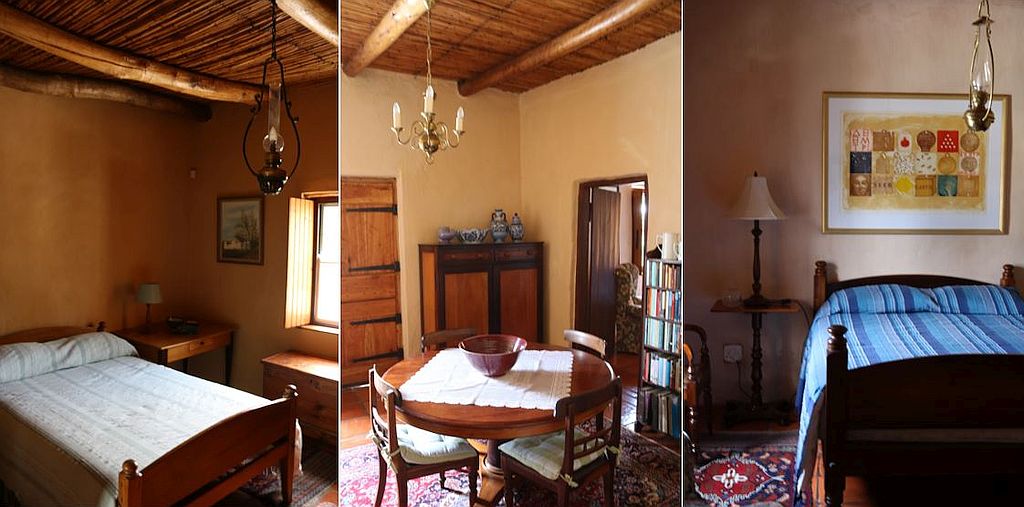
The Voorkamer limewashed with Deep Cream Limewash
One frustration encountered in maintaining the inside of the building, was that not all the walls in rooms reacted in the same way when limewashed. Although all environmental conditions were the same and the same brand of limewash was used throughout. The only variable being the selected colour shade of the limewash, differing one room from another.

The limewash on the walls in three rooms was very good and we never experienced sifting. However, in another three rooms a problem manifested where the limewash appeared to powder against the wall and constantly sift onto the floor and nearby furnishings.

To assess each room and identify anomalies that might cause this sifting, was no easy process. The rooms were all prepared in the same way prior to limewashing. The fact that the limewash contained different colour pigmentation, we thought, should not have affected the end result in that way.

Different colour limewash for different rooms 

In determining what might have gone wrong during the limewashing process, we looked closely at what could have gone wrong with the preparation of the walls and the application of the limewash. The walls were all cleaned down to remove powdery or flaking limewash. The walls were carefully dampened with water prior to, and again after limewashing, so as to ensure a slow curing process. The only variables at this stage were a possible variation in the consistency of the limewash (continuous stirring is important) and the length of time between the application of subsequent coats.

The manufacturer’s information on the drums of limewash, indicates that the limewash is ready for use after it has been stirred thoroughly. It also indicates that one can add some water to thin the limewash and that will help to apply it more easily. Multiple thin coats are preferable to one or two thick coats. I did all that the first time, so no real warning lights going on where the thickness was concerned. Did I apply the layers too soon? The manufacturer’s information indicated that it was best to let the coats dry overnight but one can paint the second coat when the first is visibly dry. Clearly, the coats were applied the correct way. The only step I might not have followed properly was to dampen the walls between coats.

The grey limewash in the drum and the end result on a bedroom wall

It did not explain why three rooms were fine and another three not.  We decided to follow every instruction to the letter when applying limewash on the interior walls this time. The walls in the first problem room were prepared by brushing with a stiff brush. After that, all the walls were vacuumed to remove any remaining dust or loose material.

The first coat of the limewash went on like a dream but as it dried, it was clear that we had not solved the sifting problem. Very despondent, we went back to our sources. We contacted the manufacturers. They could not advise us but instead freely offered two samples of their other products to apply over the limewash as a sealant. They requested that we provide feedback on our findings. Although we accepted the products, we were reluctant to use it on our walls. Sealing the walls with an acrylic water-resistant finish seemed to defeat the purpose of using limewash that expressly allows the earthen walls to breath by allowing the free passage of moisture.

We decided that the solution for a problem with a traditional product must be found in traditional usage practices. We could find little guidance and information for the use of limewash in South Africa. With the slow demise of traditional buildings in the Western Cape and the country at large, the demand for traditional building materials seems also to be reducing and with it, the associated vernacular knowledge.

Rennet Casein powder
Reading some technical advice on a British website about lime, offered some hope. Several traditional formulas consist of lime slaked and thinned to a cream to which various additions are made, such as salt, alum, powdered glue, casein (skimmed milk), etc.  Limewash that contains casein will have a better binding with the wall and the coagulation of the limewash will prevent the lime from sifting when it is dry. There is amazing information to be found about limewash and the chemical reactions of it with walls. The use of casein for architectural purposes dates to the ancient Egyptians who used lime-casein to protect renders.

Casein gives greater binding properties to clay and lime mixtures. Casein, like lime, is breathable. We decided that adding casein will provide the most likely solution to the sifting or flaking problem when the limewash is applied to the walls. A small quantity of casein added to limewash will thicken and strengthen it considerably.

Liquid rennet used in cheese making
Rennet (complex enzymes found in the stomach of a calf) and casein (a protein found in milk) are key ingredients in cheese making. Rennet casein contains casein of 100 % purity. Milk powder also contains casein but at a lower percentage, of around 80%.

After proper research, Keith set off to the largest cheese factory of the three found in our valley to enquire about buying some rennet casein in the hope of solving our limewash problem. The plant manager was very accommodating and generously provided Keith with 500g samples each of the powder products Rennet Casein and Casein with which to experiment.

Liquid rennet and casein powder
The ratio of rennet casein to limewash we found on a lime information website from the UK. We mixed 25 grams of the rennet casein powder to 1 litre of limewash. This limewash and rennet casein mixture worked like a charm. Apart from giving the wall a smooth dust free look, the limewash now also adheres to the walls without rubbing off.

Adding casein and rennet to the limewash 
For the casein mixture we used the same ratio of 25 grams of casein to 1 litre of limewash, but we added 0.166 ml (½ ml on 3 litres) of rennet. We bought a handy 100ml container of rennet from a shop in Cape Town that sells cheese-making ingredients. Adding either the ready mixed Rennet Casein or the Casein powder with the liquid Rennet product, provided the same excellent results.

The end result of using the ingredients for cheesemaking in the limewash, solved our problem. Reading about adding buttermilk to one’s limewash now makes so much sense because it is, after all, another source of casein. Knowing what casein can do for the adhesion of limewash to walls, I can understand why wall paintings from ancient Egypt still look so clear and fresh, even after the passage of thousands of years.


Adding some ingredients for cheese-making to one’s limewash does not seem so cheesy after all.


Sources:

https://www.lime.org.uk/  - Limewash Application Guide

https://www.readkong.com/page/paints-and-their-history-articles-printed-in-the-western-3348832 - Paints and their History

https://repository.upenn.edu/cgi/viewcontent.cgi?article=1382&context=hp_theses - Traditional Architectural Renders on Earthen Surfaces


Monday, 30 May 2022

Stopping our minds from wandering

Autumn has come in a flurry of leaves, reminding us that winter is around the corner. With an endless list of projects, we are slowly picking away at them. It is the story of our restoration of Towerwater, one can have the money or the time but seldom both at the same time.

Covid gave us the perfect opportunity to tackle the outstanding issues, but once again when we had the time, our finances were elsewhere committed. Sometimes serious issues like the refreshing of thatch roofs cannot wait for the right time. We decided to get a local thatcher from Montagu to do the maintenance. As part of the roof maintenance project, Keith decided to tackle the corrugated iron roof on the flat-roof section himself. 

Putting up scaffolding, exterior lime washing complete, hearth detail

Cleaning, preparing, and covering the iron roof with an eco-rubber treatment will hopefully see us through a dry winter inside the house. It was important to start with the roofs because we decided to refinish the inside of the house as well.

The freshly lime washed exterior of the main house.

The problem with home maintenance is that it seems very easy as one plans the schedule of work. The reality is that one can never foresee all the delays, stretching the project from weeks to months. By the middle of autumn, we at least completed the roofs, limewashed the cottage inside and out, and limewashed the outside of the main house and garden walls.

Busy treating the double doors to the dining room with wood protector.
Being caught up in the maintenance of the property meant that my creativity was focused on painting woodwork and preparing spaces to be painted. Writing the blog was put on the backburner. I could not allow my mind from wandering away from the task at hand.

A bedroom used to store the books from the library.
It reminded me of the Beatles song, ‘Fixing a Hole’ with the lyrics – “I'm fixing a hole where the rain gets in and stops my mind from wandering”, “I'm filling the cracks that ran through the door and kept my mind from wandering”, “I'm taking the time for a number of things that weren't important yesterday”.

Emptying the bedroom, dining room and library/lounge for painting/lime washing.

We are taking the time to attend to all the outstanding issues and going at it, room by room. Although the progress is slower than what we would have liked, all the maintenance work certainly kept our minds from wandering.

Friday, 24 December 2021

Reflections of Limewash

With the thatch roofs of the Towerwater buildings being serviced, it was the perfect opportunity to use the support structures on the roof to maintain the lime plaster roof ridging. Keith mixed lime plaster comprising sand, lime, and Portland cement in the original ratio of 8:2:1 and the thatchers repaired the roof ridging while they were on the roof.


Fungai took the opportunity to lime wash the roof ridging when the plaster work was dry and cured. His task was made easier with the roof supports tied through the thatch to the roof structure. Watching him lime wash the roof, and gable ridging was quite hair raising.

Keith painted the entrance gates, pickets, and the doors of the main house while Fungai limewashed the garden walls, pillars as well as the walls of the buildings.


A limewashed wall seems whiter than any other white paint can achieve. Reading up on limewash, I came across a very interesting description that may explain the reason. Limewash is a mixture of slaked lime (calcium hydroxide) in water which sets slowly by absorbing carbon dioxide from the air. This chemical reaction produces crystals of calcite (calcium carbonate). The crystals have a dual refractive index, meaning that the light entering each crystal is reflected in duplicate. This results in the characteristic surface glow of limewashed surfaces. This is not found in other decorative finishes.


Limewash was not used for primarily for its decorative purposes, but it was a treatment intended to protect early mud structures against the worst weather. Limewash allows a building to breathe, and that is very important when a building is built with mud or sunbaked bricks, as in the case of the Towerwater buildings. Moisture can move freely in and out of the bricks preventing the moisture from becoming trapped in the bricks and causing their decay and that of the masonry. Limewash also serves as cleansing agent and basically sterilizes the walls.


The freshly limewashed buildings of Towerwater is blinding in the Karoo sun. Looking at the brilliant beauty of the white walls, I was reminded of the coating of dual reflective crystals on the walls. Luckily, the pebbled plaster finish on the walls softens the glare by reflecting the bright sunlight in thousands of different directions.

The property looks fresh and manicured and the engraved name stands out against the white of the gate pillar, Towerwater aan de Breede. For now the enchantment of the limewashed buildings nestling among the green of the garden match the enchantment of the canal and the garden it feeds.


Other posts about limewash at Towerwater

Saturday, 26 March 2016

Lime Plaster and Lime-wash

After two weeks of not coming to Bonnievale as a result of organising restoration work to be carried out on the Cape Town cottages, it was good to be home again. Autumn came for an extended stay with the neatly mowed lawn scattered with oak leaves and the crinium moorei flowers having gone to seed.

Lime-washed wall drying
With work on the Cape Town cottages starting in April, we decided to use our leave to do some restoration work on the homestead at Towerwater. A wall had incurred some rainwater damage a while back and with clay brick building it is best to repair any exposed adobe as soon as possible.

Lime-wash freshly applied
After we cleared the voorkamer Keith mixed the adobe friendly plaster comprising of sand, building lime and cement in quantities to a ratio of 8:2:1. Although lime cures more slowly than cement, it does hold many advantages as a workable, self-healing, breathable, nearly carbon neutral material, making it much more suited to natural building practise. As the house is built with sun-baked clay bricks, it is very important that the plaster should be compatible with the original clay bricks and adobe plaster finishing of the building.

Chandelier reflecting against freshly lime-washed walls
The 8:2:1 mix is used by most restoration architects and practitioners working with old Cape Dutch buildings. We have found that it works well with the old plaster.  Traditional buildings need to ‘breathe’ so as to allow moisture in the walls to evaporate through the external plaster/render and paint finishes. Many problems on old buildings are caused by using the wrong mixture, usually cement rich, trapping moisture in the walls thereby causing bigger problems.

Drying lime-wash brush strokes
 Prior to fixing the cracks and spots of exposed adobe, the walls were dampened and again the next day, before Shawn lime-washed the room. Lime-wash is a mixture of slaked lime (calcium hydroxide) in water which sets slowly by absorbing carbon dioxide from the air. We do not mix our own lime-wash but use a ready mixed product, Glutone. The finish we get on the walls is softer, warmer and awash with reflective salt crystals.


For two days the dining-room table looked like we were planning a major drinks party with all the glasses and liquor packed out on it when Keith emptied the jonkmanskas that had to be removed from the voorkamer.

Lime-washed walls and handmade terracotta floor tiles
But the disruption was worth seeing the voorkamer in pristine condition again. Looking fresh with its two layers of peach coloured lime wash, reminiscent of the first colour to be found on the wall.