Showing posts with label rooi bolus. Show all posts

Friday, 16 December 2022

Traditional Soetkoekies with red bole (rooi bolus)

A lot of earlier recipes contain ingredients that are no longer readily available. The same goes for “outydse soetkoekie met rooi bolus” or traditional spicy cookies with red bole. A direct translation of the name of the cookies to sweet cookies from the Afrikaans soetkoekies is also not correct. The cookies in question are more spicy than sweet. 

When we started exploring the recipes for “outydse soetkoekies”, we found several variations of the recipe. Some had red bole (an iron oxide), some claret or brandy.

The recipes using the “rooi bolus” interested me because of the ingredient. I remember the two-tone cookies with the almond in the middle, but I cannot recall if the reddish part had a different flavour from the rest of the cookie.

The plain dough on the left and the dough with the "rooi bolus" on the right
It is clear from the earlier recipes that people knew from experience how to incorporate the “rooi bolus”. The recipes merely list it as an ingredient. There are no clear instructions to keep it separate for use in some of the dough that will later be incorporated in the remaining dough to create the familiar red colour patterns.

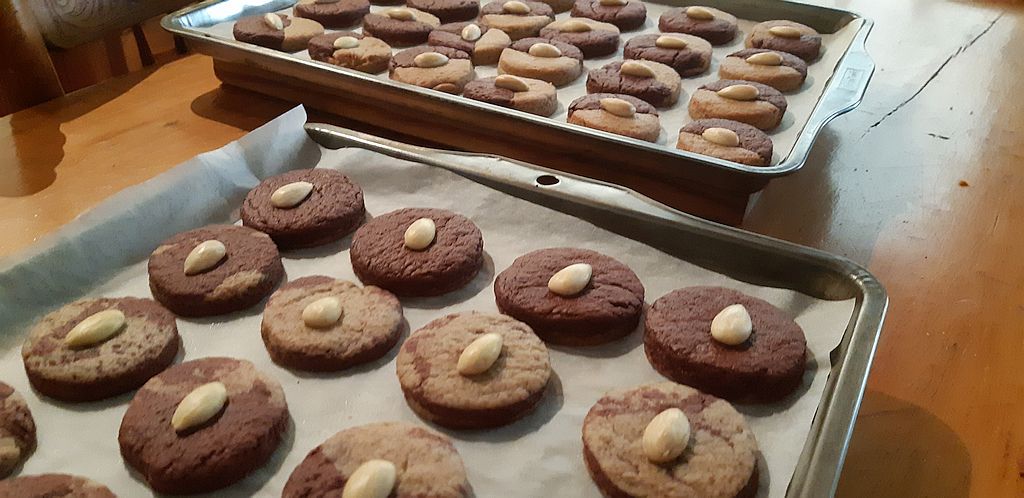
How the dough with the “rooi bolus” colouring was incorporated into the cookies, is another matter. Some people make random patterns with it. Others make dots on the dough, and some make the two-tone cookies with the almond in the middle.

The dough with the "rooi bolus" 
After reading several discussions online I discovered that I am not the only one struggling to find “rooi bolus”. After trying several chemists and spice stores without luck, I decided to do more research. 

What is “rooi bolus”, and why was it used in the recipe?

On Wikipedia I found the following information:

“Bolus is an earth pigment that occurs in nature in different colours; it can be white, yellow, red or gray. Such earth pigments are composed of clay, alumina and hydrous aluminum silicates.

The red bolus (bolus rubra) was mostly imported from Armenia and was therefore given the designation bolus armenicus, bolus armena, lutum armenum, terra armenum, etc. The coloring component is iron oxide (red ochre, Fe O ), which can be up to 20%. In addition, it mainly contains clay minerals.”

I decided to look at the definition for red bole which seems to be the accepted translation for “rooi bolus”. I found the following definition for bole on Wikipedia:

“Bole is a shade of reddish brown. The color term derives from Latin bōlus (or dirt) and refers to a kind of soft fine clay whose reddish-brown varieties are used as pigments, and as a coating in panel paintings and frames underneath the paint or gold leaf. Under gold leaf, it "warms" the colour, which can otherwise have a greenish shade. However, bole in art is a good deal more red and less brown than the modern shade; it is often called Armenian bole.

Another name for the color bole is terra rosa. The color name terra rosa has been used as a synonym for bole since 1753. The color terra rosa is classified a warm red color. In art, it's classified as being similar to Venetian red, but more pink or salmon. In French, it corresponds to the color châtaigne.

Bole is one of the oldest color names in English. The first recorded use of bole as a color name in English was in the year 1386.”
From the above information, it is clear that red bole or “rooi bolus” is a very old colouring ingredient and basically it was a red clay used for colouring paint pigments and sometimes food. Today it is still used to colour red toffee apples, Essies (another cookie of Cape Malay origin) and “Soetkoekies”.

I thought of using a readily available red food colouring when making the “soetkoekies”. After I ordered the colouring online I happened to come across a few cubes of Reckitt’s blue that I bought some time ago from the General Dealer up the road from us in Woodstock. Coronation Bazaar is one of those rare stores that seems to be caught in a time capsule. A general dealer in the true sense of the word. They stock everything from hardware, books, groceries, etc. Sometimes one will find a product that has not been seen for years.


I decided to take a chance and walk up to the shop. The owner did not even blink when I asked him for red bole or “rooi bolus”. His immediate response was, how much do you need and are you making toffee apples? He handed me the container of red bole that says “Used for Soetkoekies & “Essies”. I had searched everywhere for this elusive ingredient and all the time it was right on our doorstep. 

With my container of red bole in hand, I was ready to bake traditional “Outydse soetkoekies”. After looking at several recipes, I decided to make the recipe in The South African Culinary Tradition by Renata Coetzee, published in 1977.

Soetkoekies

500 g Cake flour
2 ml (half teaspoon) salt
2 ml (half teaspoon) ground cloves
10 ml (2 teaspoons) ground cinnamon
5 ml (1 teaspoon) ground ginger
5 ml (1 teaspoon) bicarbonate of soda
300 g (1,5 cups) sugar
200 g (0,8 cup) butter
5 ml (1 teaspoon) red bolus (ferri-oxide mixture)
1 egg
25 ml (2 tablespoons) wine

Sift dry ingredients together and rub in butter.
Beat egg and wine together. Combine ingredients and mix into a stiff dough. Leave to stand overnight. Take a piece of dough and work red bolus into it. Roll out the remaining dough to a thickness of 5mm. Arrange strips of red bolus dough on rolled out dough and roll out again, to a thickness of 5mm. Cut out rounds of dough with a glass about 50mm in diameter. Bake in hot oven (200
°C) for 10 minutes.

I decided to decorate them with a blanched almond each. To blanch almonds: bring a pot of water to the boil. Put in the almonds and boil for 1 minute only. Drain and rinse them in cold water to stop them from cooking. The peels will rub off very easily.

After 10 minutes, I could marvel at the trays of childhood memories coming out of the oven. Tasting the cookies I realised that the red bolus was strictly for decorative purposes and had no impact on the flavour.


Wednesday, 10 June 2020

Outydse soetkoekies

Gedurende die tydperk van isolasie en beperkte besoeke aan winkels en die supermark, het ons geleer om meer tuisgemaakte produkte voor te berei en geniet. Ons het laas in Desember 2019 ‘n winkelbrood gekoop. Heeltemal reg, ons het toe nog nie geweet wat wag vir ons met die virus wat in China kop uitgesteek het nie. Maar reeds toe het Keith begin soek na gesonder opsies vir winkelbrood. Winkelbrood is gestroop van alles wat goed is in brood.


Keith se brood bakkery het ons natuurlik goed te pas gekom gedurende die grendeltyd. Met net ‘n paar frustrerende tekorte aan steengemaalde meel aan die begin van die isolasie periode. Die reuk van varsgebakte brood het die kombuis gevul met nostalgiese herinneringe van kleintyd.

Die Skrif sê, “‘n mens kan nie van brood alleen lewe nie”, en dit is baie waar. Mens het darem so ‘n soetigheid nodig saam met ‘n lekker koppie tee.

Keith het besluit om klein koekies te bak vir die bederf saam met die oggend en middag tee. Die keuse van klein koekie resepte in die historiese kookboeke in die Towerwater biblioteek was eindeloos. Maar wat is nou meer eg Suid Afrikaans as ‘n baksel outydse soetkoekies.


Outydse soetkoekies bak is soos om plaat vir plaat herinneringe in die oond te steek. Die reuk van speserye vertel ‘n storie van skepe wat van Portugal om die Kaap van Storms, of soos dit in die 15de eeu bekend gestaan het, “Cabo das Tormentas”, geseil het na die spesery eilande.

Ek hou van die woord “Tormentas” om die Kaap te beskryf. Enige een wat al in die Kaap was tydens ‘n sterk Suidooster, weet watter marteling dit kan wees. Die spesery eilande of Molukke was die enigste plek waar naeltjies en neutmuskaat gegroei het. Die feit dat skeepvaarders bereid was om die onbekende oseane aan te durf om hierdie speserye te bekom, is ‘n bewys hoe waardevol speserye was. Vandag kan ons gelukkig enige spesery by die naaste winkel gaan koop. 

Speserye is nie net ‘n geurmiddel vir kos nie, maar inspireer menige digters en skrywers om hulle lof te besing. Selfs D.J. Opperman se herinnering aan vroue in sy lewe word gekenmerk deur die reuk van speserye. So verwoord hy die plesier van onthou in sy gedig Sproeireën, “My nooi is in 'n nartjie, my ouma in kaneel, daar's iemand... iemand in anys, daar's 'n vrou in elke geur!”

Soos plaat na plaat outydse soetkoekies uit die oond kom, word die huis gevul met die warm reuk van naeltjies, gemmer en kaneel. Ek onthou hoe my ma in Oktober elke jaar begin koekies bak het vir Desembermaand se kuiergaste. Daar is niks beter om ‘n honger kind tevrede te hou tussen etenstye as ‘n outydse soetkoekie in elke hand nie.


Die resep wat Keith gebruik het vir die outydse soetkoekies is as volg,

Outydse Soetkoekies

Bestandele
  • 6 koppies (1½l) koekmeel
  • 1 teelepel (5ml) kremetart
  • 1 teelepel (5ml) koeksoda
  • 1 teelepel (5ml) sout
  • 1 teelepel (5ml) fyn gemmer
  • 1 teelepel (5ml) fyn kaneel
  • ½ teelepel (2,5ml) fyn naeltjies
  • 2½ koppies (625ml) suiker
  • 1 koppie (250ml) botter
  • 1 koppie (250ml) vet
  • 4 eiers
  • 2 eetlepels (30ml) brandewyn
Metode
  1. Sif al die droë bestandele saam en meng dit goed. Voeg dan die suiker by en meng dit verder saam.
  2. Vryf die botter en vet met die vingerpunte in die droë mengsel.
  3. Voeg die brandewyn en die geklitste eiers by en meng tot dit ‘n stywe deeg vorm.
  4. Rol die deeg dun (3mm) uit en druk dit met ‘n koekie drukker uit.
  5. Bak dit vir 10 tot 15 minute lank in ‘n warm oond by 200 °C 


In "Hilda's "Where is it"? of recipes", gepubliseer in 1891, het ek die volgende resep gekry vir zoete koekies.

"TEA CAKES ("ZOETE KOEKIES")
(Very old Dutch Recipe. Mrs. Van der Riet.)

Ingredients 
4 lb. of Flour.
3 lb. of good clear Brown Sugar.
1 lb. of Butter.
½ lb. of Sheep-tail Fat.
1 lb. of Pounded Almonds (or 200 Almonds pounded without blanching).
4 Eggs
1 tablespoonful of Potash or Carbonate of Soda.
1 tablespoonful of Cloves (finely pounded).
2 tablespoonfuls of Cinnamon.
A tumbler of Dark Wine (Claret)

First rub flour, sugar, butter, spices, and soda well together; lastly, add the wine; knead all well together. If potash is used, it must be dissolved in the wine - is best mixed over-night. Roll the dough out with a rolling-pin; make into shapes with a wineglass or any thin shape.  Bake on buttered tins. The old Dutch people put a small piece of citron preserve in the centre of each little cake. Bake for twenty minutes in a tolerably brisk oven. Very good."

Van die resepte vir outydse soetkoekies wat ek aanlyn kon kry verwys na die gebruik van rooi bolus in die tradisionele resep. Outydse soetkoekies is moontlik met rooi bolus gekleur in die tyd voor voedsel kleursel geredelik beskikbaar was. Die rooi bolus word beskryf as ‘n “ferrous oxide” wat dit dus ysteroksied maak.

Die resepte vir soetkoekies in die resepte boeke van A.G. Hewitt (1890), H Duckitt (1891), E.J.Dijkman (1891), M Higham (1917), S. van H. Tulleken (1922) en H Gerber (1950), gebruik nie een rooi bolus in die resep nie. Ek weet nie wanneer rooi bolus die eerste keer in 'n soetkoekie resep gebruik is nie, maar dit kom nie voor in die vroegste gepubliseerde tradisionele resepte nie. 

Ek het wel 'n resep vir "Boere Koekies" in A.G. Hewitt se resepte boek gekry wat "roode bolus" bevat maar die resep bevat geen speserye nie. Sy het wel 'n resep vir "Old-fashioned Sweet Cakes" wat speserye bevat maar geen rooi bolus nie. 

Wat ek wel uitgevind het is dat yster oksied wat as voedsel kleursel gebruik word deur die Europese Unie as Yster Oksied E172 gelys en dit kan in swart, rooi en geel voorkom. My mening is dat dit die koekies ‘n bruiner eerder as ‘n rooi kleur gegee het. 

In die boek, Outydse Reseppies uitgegee in 1952 deur Maskew Miller is die volgende resep vir outydse soetkoek met rooi bolus in,

"Outydse Soetkoek

6 koppies fynmeel
1 koppie  botter
1 koppie  varkvet
2 koppies suiker
3 eiers
1 teelepel koeksoda
2 teelepels kremetart
1 teelepel rooibolus
1 teelepel fyn kaneel, gemmer en neut gemeng

Meng al die droë bestandele en vryf die botter en vet goed daarin. Meng alles met die eiers, knee deeglik en rol dun uit. Sny in vierkantjies of druk af met 'n vormpie en bak in warm oond (400° F) omtrent 20 minute." 


Klik op die skakel vir 'n resep vir outydse soetkoekies met rooi bolus in.
Gebruik gerus die vertaal funksie, regs bo op die volledige webblad om die Afrikaanse weergawe te lees.